Southeast Asia''s Trade and FDI Boom: The New Engine of Global Supply Chains
Southeast Asia is reshaping global trade and finance, attracting a record
Southeast Asia's Trade and FDI Boom: The New Engine of Global Supply Chains
Southeast Asia is no longer merely a stopover on global trade routes—it is rapidly becoming a destination. In 2023, the region attracted a record $230 billion in foreign direct investment, capturing 17% of global FDI flows and ranking second only to the United States, according to BofA Global Research. This surge is not a fleeting anomaly. It reflects a structural reordering of global supply chains, as multinationals move beyond China-centric strategies and embed deeper roots in ASEAN economies. At the same time, the region's share of world trade has climbed to 8%, driven by an explosive export growth in Cambodia (225%), Vietnam (170%), and Thailand (80%) between 2018 and 2023. With the IMF projecting GDP growth of 6.5% for Vietnam and 5.4% for the Philippines by 2025, Southeast Asia is emerging as the critical node for supply chain diversification and next-generation trade networks.
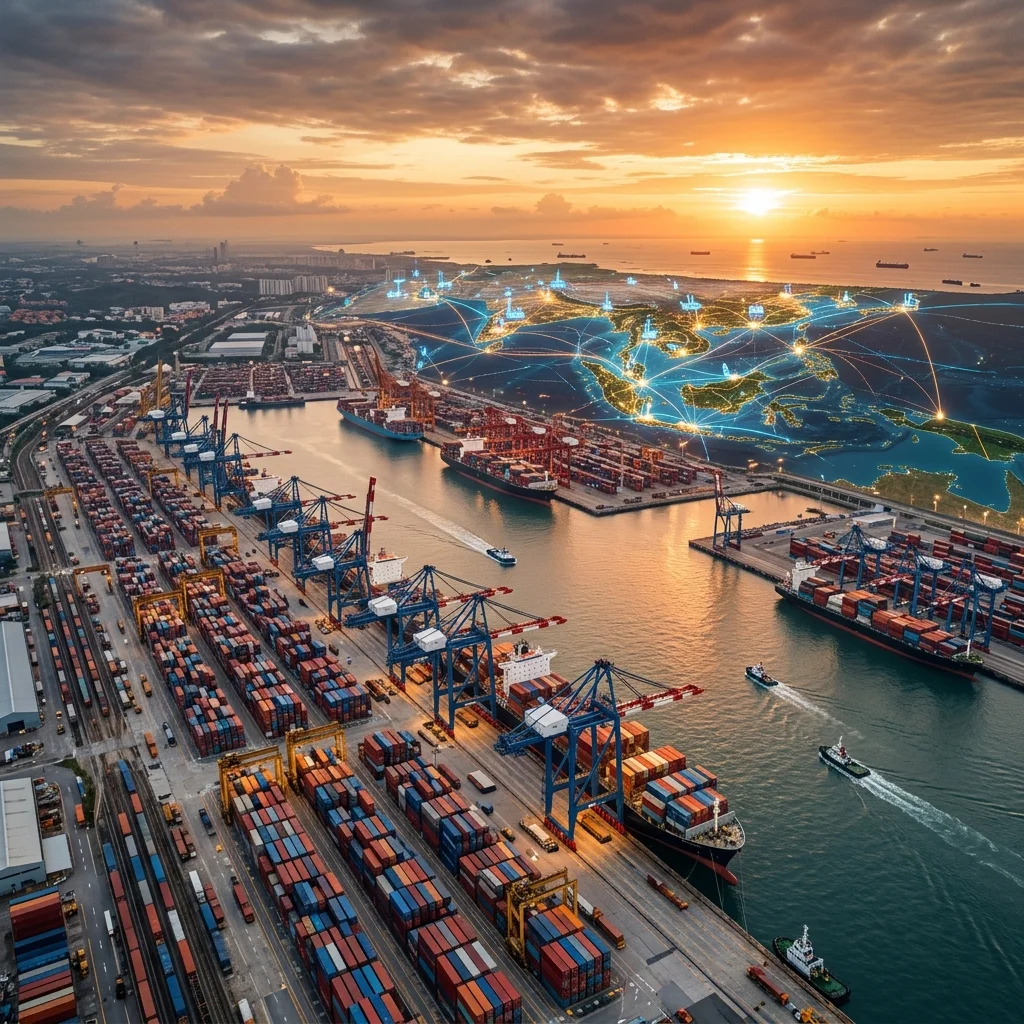
[IMAGE: A cinematic aerial view of a modern Southeast Asian port at sunrise, with cargo ships and container cranes visible; in the background, a glowing digital network overlay connecting factories, data centers, and trade routes across a map of the region. No text, no watermark, photorealistic style.]
---
1. The Record Inflow: Why $230 Billion FDI Signals a Structural Shift
The numbers are staggering. Southeast Asia’s $230 billion FDI haul in 2023 accounted for 17% of global inflows, more than double its share a decade ago. The driving force? A deliberate pivot by global corporations to build resilient, multi-country supply chains. This is not a cyclical spike tied to temporary disruptions; it is a fundamental re-routing of capital.
Manufacturing FDI alone has exceeded $40 billion annually for three consecutive years. Vietnam, Malaysia, and Indonesia have become the primary beneficiaries. Vietnam attracted over $27 billion in manufacturing FDI in 2023, much of it flowing into electronics assembly and semiconductor packaging. Malaysia registered a record $33 billion in approved investments, led by data centers and chip fabrication. Indonesia secured commitments from global EV battery makers, with $15 billion earmarked for nickel processing and battery plants.
What makes this structural? Two forces are at work. First, the ongoing supply chain diversification away from China has accelerated since the U.S.-China trade war and the pandemic. Companies are adopting a "China+1" or even "China+multiple" strategy, and Southeast Asia's proximity, cost competitiveness, and improving infrastructure make it the natural alternative. Second, a web of free trade agreements is locking in these investment flows. The upgraded ASEAN-China Free Trade Agreement (ACFTA 3.0), finalized in 2024, explicitly covers artificial intelligence, fintech, and green technologies, reducing tariff barriers and creating legal certainty for cross-border operations. Similarly, the Regional Comprehensive Economic Partnership (RCEP), which entered force in 2022, harmonizes rules of origin across 15 economies, making it cheaper and easier for companies to build regional value chains.
[IMAGE: Infographic showing FDI flow into Southeast Asia by country and sector, with arrows from US/China/Japan. Key data: $230B total, 17% global share, top recipients: Singapore, Indonesia, Vietnam, Malaysia.]
This is not a story of low-cost labor alone. The nature of investment is shifting. In the 2010s, FDI often targeted assembly lines for garments and basic electronics. Today, investors are building semiconductor fabrication plants, EV battery gigafactories, and R&D centers. The region is moving up the value chain, and the capital flows reflect that ambition.
---
2. From Assembly to Advanced Manufacturing: The New Industrial Hubs
Between 2018 and 2023, Cambodia’s exports surged 225%, Vietnam’s 170%, and Thailand’s 80%. These figures are not merely about volume—they signal a qualitative transformation. The region is no longer just assembling imported components; it is producing sophisticated intermediate and final goods that sit at the heart of global tech supply chains.
Consider the semiconductor industry. Malaysia already accounts for 13% of global chip packaging and testing, and it is attracting billions in new investment from global players like Infineon, Intel, and AT&S. Vietnam is emerging as a destination for chip assembly and design, with Samsung’s $2.2 billion semiconductor plant in Hoa Lac and upcoming investments from Marvell and Qorvo. Indonesia, meanwhile, is building an entire EV battery ecosystem, leveraging its rich nickel reserves to attract Hyundai, LG Energy Solution, and CATL. Thailand has become a regional hub for EV assembly, with Toyota, Honda, and Chinese automakers like BYD and Great Wall Motor setting up production lines.
Southeast Asia trade patterns reveal the emergence of a self-reinforcing ecosystem. Intra-Asian trade now accounts for over half of all regional trade, up from about 35% four decades ago. Intermediate goods—such as electronic components, automotive parts, and chemicals—flow between ASEAN members before being assembled into final products for export to the U.S., Europe, and the rest of Asia. This deepens the region's integration into global semiconductor hubs and advanced manufacturing networks.
[IMAGE: Photo of a modern semiconductor fabrication facility in Malaysia or Vietnam, with cleanroom workers in white suits. Caption: Malaysia and Vietnam are becoming critical nodes in global chip supply chains.]
The rise of ASEAN manufacturing is also reflected in the World Bank's Logistics Performance Index, where Singapore ranks first globally once again, and Malaysia, Thailand, and Vietnam have all improved their scores. Better ports, roads, and digital connectivity are making it feasible to coordinate complex production across multiple countries. For example, an electronics supply chain might involve raw materials from Indonesia, component assembly in Vietnam, final testing in Malaysia, and export through Singapore’s port—all within a week.
This is a far cry from the old model of "make in China, ship to the world." Southeast Asia is building its own manufacturing ecosystem, and the numbers show it is working.
---
3. The Digital Backbone: MLETR, RCEP, and the Fintech Layer
Physical factories are only half the story. The other half is the digital infrastructure enabling cross-border trade and finance to function at speed and scale. Here, Southeast Asia is making quiet but pivotal moves.
Singapore’s 2021 ratification of the UN Model Law on Electronic Transferable Records (MLETR) is a landmark but underappreciated step. MLETR legalizes digital versions of trade documents such as bills of lading, promissory notes, and warehouse receipts. For decades, global trade has been bottlenecked by paper-based documentation that takes days to process. With MLETR, Singapore allows digitized records to have the same legal effect as paper, unlocking faster cross-border financing, reducing fraud, and lowering transaction costs. As other ASEAN members consider similar legislation, the region could become the first fully digital trade bloc in Asia.
The Regional Comprehensive Economic Partnership (RCEP) amplifies this effect. By harmonizing rules of origin across 15 Asia-Pacific economies—including China, Japan, South Korea, Australia, and New Zealand—RCEP reduces administrative burdens for companies that source inputs from multiple countries. For digital trade, RCEP also includes provisions on electronic signatures, data localization, and consumer protection, creating a regulatory framework that encourages e-commerce and fintech innovation.
[IMAGE: Abstract digital illustration of a blockchain network connecting trade nodes across Southeast Asia, with glowing data pathways linking Singapore, Bangkok, Hanoi, and Jakarta. No text.]
In parallel, the upgraded ASEAN-China FTA explicitly covers AI, fintech, and green technologies. This creates a regulatory sandbox for new business models: blockchain-based trade finance, smart contracts for supply chain payments, and AI-driven logistics optimization. With 650 million consumers and one of the world’s highest smartphone penetration rates, Southeast Asia is uniquely positioned to pilot these technologies. The result is a virtuous cycle: more digital trade leads to lower costs, which attracts more manufacturing, which drives further investment in digital infrastructure.
These developments are also attracting fintech startups and global payment companies. Singapore’s central bank, the Monetary Authority of Singapore, has pioneered Project Ubin and Project Guardian to test tokenized assets and cross-border payments. Meanwhile, Indonesia and Thailand are advancing QR-code-based cross-payment systems, allowing consumers and businesses to transact seamlessly across borders. This infrastructure lowers the barrier for small and medium enterprises to participate in global trade, broadening the region's economic base.
---
Conclusion: The New Engine of Global Supply Chains
The evidence is clear: Southeast Asia is not merely riding a wave of cyclical demand. It is building the factories, the trade agreements, and the digital rails that will define global supply chains for the next decade. FDI trends show capital flowing into higher-value sectors—semiconductors, EVs, advanced electronics—rather than basic assembly. RCEP impacts and upgraded FTAs are reducing barriers and creating a stable legal environment. And the region's embrace of digital trade tools like MLETR is greasing the wheels of commerce.
Of course, challenges remain. Infrastructure gaps persist in Myanmar, Laos, and Cambodia. Talent shortages in tech fields are a growing concern. Geopolitical tensions—including the U.S.-China rivalry and South China Sea disputes—could disrupt progress. But the trajectory is unmistakable. With Vietnam heading toward 6.5% GDP growth, the Philippines at 5.4%, and major economies like Indonesia and Malaysia powering ahead, Southeast Asia is becoming the new engine of global supply chains.
For investors, policymakers, and business leaders, the message is simple: the region that was once considered an alternative to China is now becoming the primary hub in its own right. The $230 billion in FDI in 2023 is not a record to celebrate in isolation—it is the first chapter of a long-term structural shift.
[IMAGE: A split-screen infographic comparing GDP growth projections for 2025: Vietnam 6.5%, Philippines 5.4%, Indonesia 5.1%, Malaysia 4.5%, Thailand 3.2%, Singapore 2.5%. Source: IMF.]