The Hidden Currents: How South Asia’s Trade and Investment Landscape Is Reshaping
South Asia is often viewed as a secondary actor in global trade, but a confluence
The Hidden Currents: How South Asia’s Trade and Investment Landscape Is Reshaping Global Supply Chains
Introduction: The Quiet Revolution in South Asia’s Trade Architecture
For decades, South Asia has lived in the shadow of East and Southeast Asia when it comes to global trade narratives. The world’s attention has been fixed on China’s factory floors, Vietnam’s export surges, and the intricate supply webs of Malaysia and Thailand. Meanwhile, a quieter but structurally significant transformation has been underway in a region stretching from the Hindu Kush to the Bay of Bengal. Recent data from UN Comtrade and the Asian Development Bank reveals a startling trend: intra-regional trade within South Asia is growing at roughly twice the rate of extra-regional trade. This is not a statistical blip but a signal that the region’s economic architecture is being rewritten.
The core thesis of this article is straightforward: South Asia is not simply a low-cost manufacturing alternative to China or Southeast Asia. Rather, it is evolving into a services-and-infrastructure-driven trade hub, where digital platforms, cross-border energy grids, and logistics corridors function as invisible enablers. The real investment opportunity lies not in building more garment factories or assembly lines, but in positioning capital along the arteries that connect these economies: logistics infrastructure, fintech platforms, and data corridors that facilitate cross-border digital services trade.
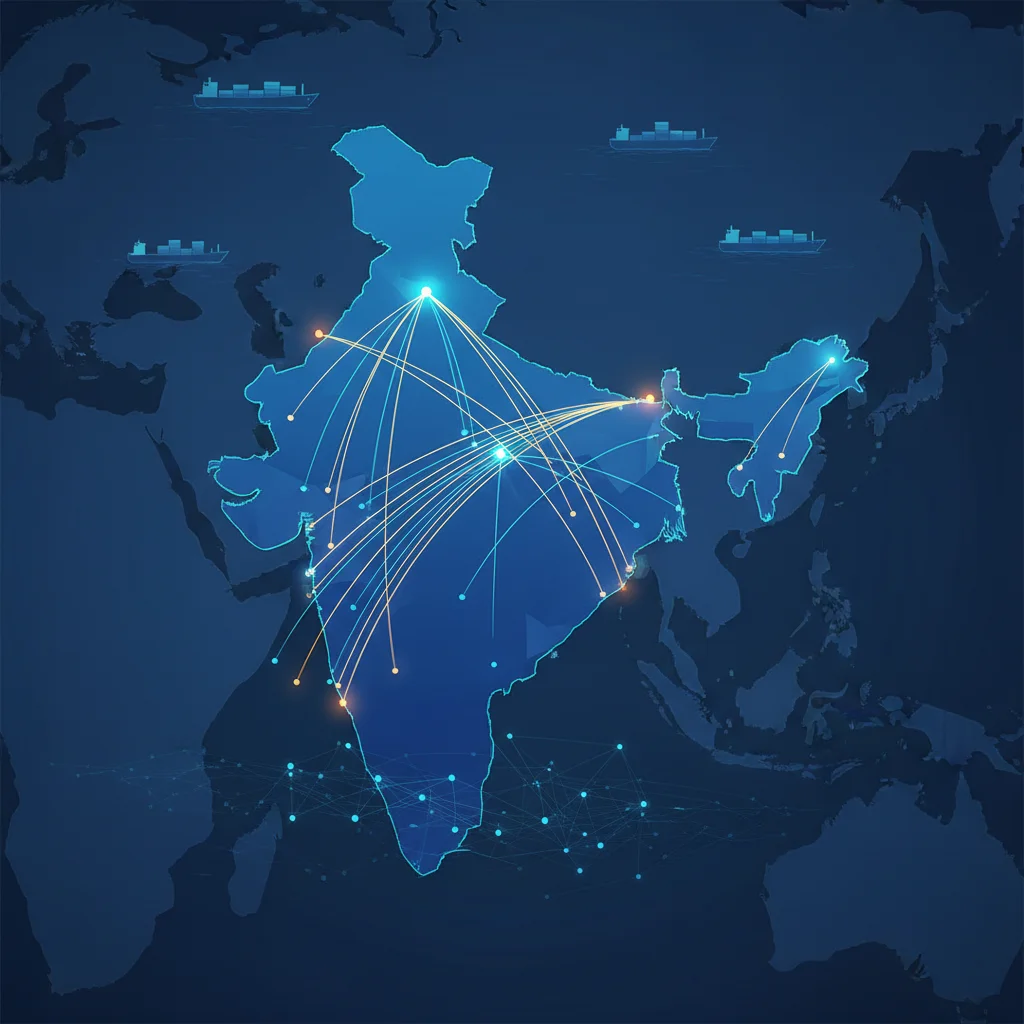
[IMAGE: Annotated map of South Asia with trade corridor flows (e.g., India-Bangladesh land ports, Colombo port, Chabahar).]
The narrative of South Asia as a secondary actor in global supply chains is becoming outdated. A confluence of geopolitical shifts — the US-China trade decoupling, the push for supply chain diversification, and the rise of digital trade — is turning the region into a critical node. This article digs beneath the surface-level growth numbers to uncover the underlying economic logic: the rise of intermediate goods trade, the quiet expansion of cross-border digital services, and the structural imbalance between India’s outbound investment and its neighbours’ dependence on remittances. Understanding these hidden currents is essential for anyone assessing investment risk and opportunity in the new global trade landscape.
The First Fault Line: Beyond Garments and IT — The Rise of Intermediate Goods
South Asia’s export story has long been dominated by two pillars: Bangladesh’s ready-made garments and India’s information technology (IT) services. That binary, however, is fracturing. In Bangladesh, apparel still accounts for over 80% of exports, but a quiet diversification is underway. Pharmaceutical exports from Bangladesh grew by nearly 15% annually over the past five years, driven by investments in active pharmaceutical ingredients (APIs) and generic drug manufacturing. Electronics components — particularly from Sri Lanka and India — are also gaining share, with India’s production-linked incentive (PLI) schemes boosting local assembly of mobile phones, semiconductors, and automotive electronics.
The most telling metric comes from intra-regional trade data. According to UN Comtrade, the share of intermediate goods — parts, components, semi-finished products — in trade flows between South Asian countries has risen from 35% to 52% over the last decade. This shift is profoundly significant. It means that regional economies are no longer simply exporting final goods to the West; they are increasingly supplying each other with inputs for production. India exports auto components to Bangladesh for assembly; Bangladesh ships textile yarns back to India for processing; Sri Lanka supplies rubber-based intermediates to Pakistan for tyre manufacturing.
[IMAGE: Bar chart comparing export categories for India, Bangladesh, and Pakistan in 2010 vs. 2024.]
The deep insight here is that this compositional change reduces the region’s dependence on final-assembly hubs — factories that simply screw parts together and ship finished products to Western retailers. Instead, South Asia is building its own regional value chains in auto parts, chemicals, machinery, and electronics. For supply chain diversification, this is a double-edged sword: it offers resilience through local sourcing, but also creates new exposure to political disruptions within the region. Investors tracking supply chain diversification trends should look beyond headline export numbers and focus on the rising share of intermediate goods — a leading indicator of deeper industrial integration.
The Infrastructure Gambit: How Corridor Diplomacy Is Forcing Economic Integration
If intermediate goods are the content of South Asia’s new trade, infrastructure corridors are the containers that carry them. Three major initiatives are reshaping the region’s connectivity, each with distinct geopolitical fingerprints but a common economic denominator: reducing trade costs. The China-Pakistan Economic Corridor (CPEC) has poured billions into road, rail, and port projects linking Pakistan’s Gwadar deep-sea port to China’s Xinjiang region. India’s connectivity push with Bangladesh — including the Maitree Setu bridge over the Feni River, the Akhaura-Agartala rail link, and the newly operational Khulna-Mongla rail line — has slashed transit times for goods moving between India’s north-east and Bangladesh’s Chittagong port. The India-Middle East-Europe Corridor (IMEEC), announced at the 2023 G20 summit, promises to link India to the Gulf via rail and sea, potentially bypassing traditional chokepoints.
Data on port throughput underscores the impact. Colombo port, a transshipment hub for South Asia, saw container volumes rise by 6.3% in 2023, driven partly by increased transshipment of intermediate goods bound for Bangladesh and India. Tariff reductions under the South Asian Free Trade Area (SAFTA) and bilateral agreements have further lowered barriers. A World Bank study estimated that the full implementation of the India-Bangladesh connectivity projects could reduce trade costs by 20–30% for landlocked Nepal and Bhutan, unlocking new investment in energy trade — both hydroelectricity from Nepal to India and cold-chain logistics for perishable agricultural products.
[IMAGE: Comparison table of infrastructure project completion stages and projected trade cost reductions.]
The deep insight is that while geopolitics dominates media headlines — CPEC as a strategic rivalry, IMEEC as a counterbalance to China’s Belt and Road — the real economic impact is more mundane but more transformative. For landlocked countries like Nepal and Bhutan, these corridors slash logistics costs that have historically been a barrier to export diversification. For investors, the opportunity is not in the grandiose ribbon-cutting ceremonies but in the secondary effects: the need for warehousing, cold storage, fleet management, and cross-border payment systems that rail and road connectivity creates. Pakistan infrastructure investments, for example, have spurred the development of new industrial zones around CPEC routes, attracting foreign direct investment in textiles and cement. South Asia economic integration is being forced not by political will but by concrete and asphalt.
The Digital Trade Engine: Fintech, E-commerce, and the Unseen Investment Flow
The most overlooked dimension of South Asia’s transformation is the surge in digital services trade — a sector that does not rely on physical corridors but on data pipes and payment rails. India’s services exports, long associated with IT outsourcing, have evolved dramatically. Cloud computing, artificial intelligence (AI) solutions, and business process automation now account for a growing share of India’s $340 billion services export basket. But the real story is cross-border digital services within South Asia. Regional fintech platforms like bKash in Bangladesh, JazzCash in Pakistan, and India’s Unified Payments Interface (UPI) are creating a seamless layer of financial connectivity.
UPI has been integrated with Singapore’s PayNow and Nepal’s Fonepay, allowing real-time cross-border payments. In 2023, the volume of digital transactions between India and Bangladesh via UPI-linked apps doubled. This is more than a convenience story: it is changing the structure of trade finance. Small and medium enterprises (SMEs) that previously relied on informal hawala channels can now use digital payment rails to settle invoices instantly, dramatically increasing trust and lowering working capital costs.
[IMAGE: Infographic showing growth of cross-border digital payment transactions between India, Bangladesh, and Pakistan, 2020–2024.]
E-commerce platforms are another conduit. Indian e-commerce players like Flipkart and Meesho are expanding into Bangladesh and Sri Lanka, while cross-border marketplaces such as Daraz (owned by Alibaba) link Pakistan, Bangladesh, and Nepal. This creates demand for cross-border logistics, last-mile delivery networks, and digital warehousing solutions. The investment flow here is largely unseen in traditional trade statistics but is captured in venture capital data: fintech and logistics tech startups in South Asia raised over $4 billion in 2023, with a significant portion dedicated to cross-border solutions.
For investors, the key message is that digital services trade in South Asia is expanding faster than merchandise trade. This is a services-led, connectivity-driven integration that is redefining investment risk. India trade policy has actively promoted this through bilateral fintech agreements, while Bangladesh export growth in IT-enabled services is beginning to complement its traditional apparel strength. The region is not trying to replicate the manufacturing-led model of East Asia; it is building a different kind of supply chain — one where data, payments, and digital trust are the most valuable assets.
---
The hidden currents of South Asia’s trade and investment landscape are reshaping global supply chains in ways that conventional metrics miss. The rise of intermediate goods is regionalizing production. Infrastructure corridors are lowering the cost of moving goods. And digital platforms are creating a frictionless layer for services and finance. For companies and investors looking beyond the hype of low-cost manufacturing, the real opportunities lie in logistics, fintech, and data corridors that are quietly knitting South Asia into a coherent economic space. The region’s story is not about leapfrogging in factories, but about building a services-led integration that may prove more resilient — and more profitable — than the assembly-line model of the past.