Beyond the Pause: Decoding the RBI''s Strategic Hold and Its Unspoken Economic
The Reserve Bank of India''s decision to hold the repo rate at 6.5% on April
Beyond the Pause: Decoding the RBI's Strategic Hold and Its Unspoken Economic Signals
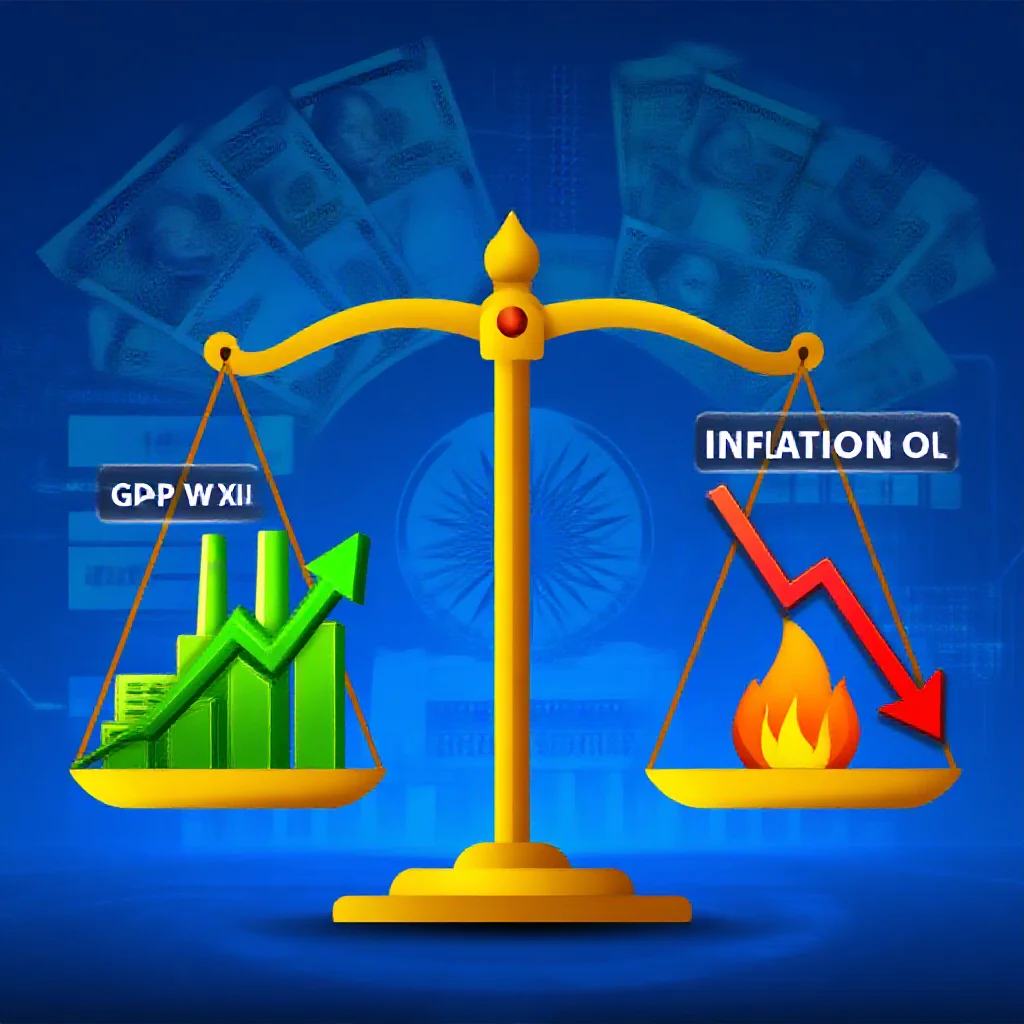
Article Summary: The Reserve Bank of India's decision to hold the repo rate at 6.5% on April 5, 2024, was widely anticipated. Yet, beneath this surface-level status quo lies a strategic recalibration. This analysis moves beyond the headline to explore the dual narrative of the RBI's policy: a 'withdrawal of accommodation' stance paired with a significant upward revision of GDP growth to 7.0% for FY25. We examine the expert consensus that views this as a calibrated pause, designed to fortify economic stability while the central bank navigates the delicate balance between fostering growth and its unwavering 4.5% inflation target.
---
The Calibrated Pause: Dissecting the April 2024 MPC Announcement
On April 5, 2024, the Reserve Bank of India’s (RBI) Monetary Policy Committee (MPC) announced its decision to maintain the benchmark repo rate at 6.5%. This marked the seventh consecutive meeting where the key policy rate was held steady (Source 1: [RBI MPC Announcement, April 5, 2024]). The decision was contextualized within a global economic landscape marked by persistent geopolitical tensions and volatile commodity prices, and a domestic environment showing robust economic activity.
The numerical outcomes of the meeting presented a dual narrative. While the Consumer Price Index (CPI) inflation projection for fiscal year 2024-25 was retained at 4.5%, the committee executed a significant upward revision in its Gross Domestic Product (GDP) growth forecast to 7.0% from the previous 6.5% (Source 2: [RBI MPC Forecast Revision]). The core guiding principle, however, was articulated in the policy stance. RBI Governor Shaktikanta Das stated, "The MPC also decided by a majority of five out of six members to remain focused on withdrawal of accommodation to ensure that inflation progressively aligns to the target, while supporting growth" (Source 3: [Governor Shaktikanta Das Statement]).
This combination—an unchanged rate, a raised growth outlook, and a reiterated tight stance—frames the decision not as passive inaction but as a strategic, calibrated pause.
Expert Decoder Ring: Reading Between the Lines of Consensus
Financial market analysts and economists uniformly characterized the MPC’s decision as anticipated, yet strategically significant. Aditi Nayar, Chief Economist at ICRA, noted, "The RBI’s decision to maintain the status quo on policy rates was on expected lines" (Source 4: [Aditi Nayar, ICRA Commentary]). This expectation was rooted in preceding data trends and the central bank's recent communications.
The critical interpretation centered on the RBI's forward guidance, or perceived lack thereof. Suvodeep Rakshit, Senior Economist at Kotak Institutional Equities, observed, "The RBI remains non-committal on the future policy path, maintaining its stance of withdrawal of accommodation" (Source 5: [Suvodeep Rakshit, Kotak Institutional Equities]). This tactical ambiguity serves a specific purpose: it prevents the market from pricing in premature rate cuts, thereby maintaining tight financial conditions necessary to anchor inflation expectations, without explicitly committing to further hikes.
Analysts from CareEdge Ratings and Bandhan Bank contributed to a consensus view that the policy's primary aim is to "strengthen the economic environment." The calibrated pause allows previous rate hikes to fully transmit through the economy while providing a stable platform for growth, avoiding policy-induced volatility that could disrupt investment and consumption plans.
The Dual Mandate Tightrope: Growth Optimism vs. Inflation Vigilance
The policy’s apparent contradiction—signaling growth confidence alongside policy tightness—is resolved through a forward-looking, pre-emptive framework. The upward revision of the GDP forecast to 7.0% acknowledges the observed and projected strength in domestic demand, manufacturing, and services. Concurrently, the unwavering "withdrawal of accommodation" stance and the 4.5% inflation target signal that this growth cannot be fueled by loose monetary policy.
The strategic hold is less a reaction to current data and more an exercise in creating policy space. It builds a macroeconomic buffer against potential future shocks from global oil price fluctuations, food supply disruptions, or renewed geopolitical strife. By holding rates steady, the RBI allows the cumulative 250 basis points of hikes implemented since May 2022 to complete their disinflationary work across the economy.
The long-term impact on credit cycles will be defined by this extended period of stability. For the next 2-3 quarters, corporate borrowing costs are likely to remain elevated, preserving the incentive for disciplined capital expenditure. Banking sector net interest margins may face compression as the rate hike transmission to deposits catches up, affecting profitability. The transmission mechanism itself enters a critical phase where the focus shifts from policy rate changes to how effectively existing tightness permeates through lending and deposit rates across all bank portfolios. This "strategic hold" period will test the resilience of both corporate balance sheets and bank asset quality in a high-growth, moderately high-interest-rate environment.
Conclusion: A Vigilant Foundation for the Fiscal Year
The April 2024 monetary policy review establishes a vigilant foundation for fiscal year 2024-25. The RBI has communicated a clear hierarchy of objectives: inflation alignment to the 4.5% target remains the non-negotiable precondition for sustained growth. The upgraded GDP forecast reflects confidence in underlying economic momentum, not a signal for policy easing.
Market predictions following the announcement suggest a prolonged period of status quo in the repo rate. The timing of any future policy shift will be strictly data-dependent, with a particular focus on the sustainability of inflation moderation, especially in food prices, and the evolution of core inflation. The central bank's strategic pause, therefore, is an active holding pattern—a period of observation and reinforcement designed to ensure that India's economic growth is built on a stable, non-inflationary foundation. The unspoken signal is one of disciplined optimism, where growth is welcomed but not at the cost of macroeconomic stability.