Global Trade in the Post-Pandemic Era: The Great Fragmentation and the Rise
The pandemic exposed deep vulnerabilities in global supply chains, triggering
Global Trade in the Post-Pandemic Era: The Great Fragmentation and the Rise of Digital Commerce
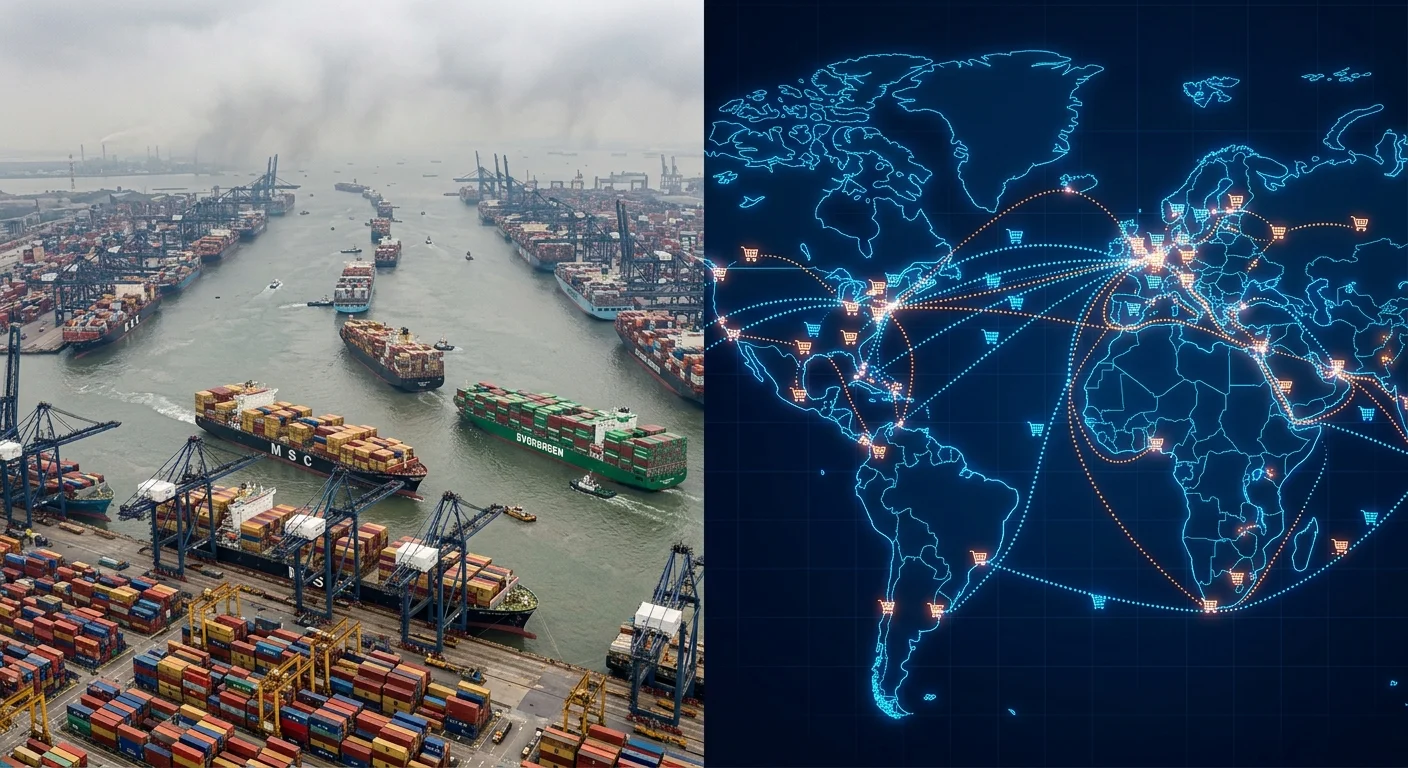
The COVID-19 pandemic did not merely disrupt daily life—it shattered the foundational assumptions of global trade. After decades of deepening integration, the world economy experienced a sudden, violent reversal. In 2020, global trade volumes plummeted by 5.3%, the sharpest contraction since the 2008 financial crisis, according to the World Trade Organization. Yet beneath this headline statistic lies a more complex story: the crisis simultaneously triggered a wave of protectionism and fueled the fastest acceleration of digital commerce in history. The result is a global trading system that is simultaneously fragmenting into regional blocs and converging through digital platforms. Understanding this paradox is essential for policymakers, business leaders, and investors navigating the post-pandemic landscape.
[IMAGE: A split composition: left side shows a congested maritime port with container ships queuing under a hazy sky, while right side shows a glowing digital world map with dotted trade routes and small shopping cart icons.]
The Shock: How COVID-19 Fractured Global Supply Chains
The pandemic’s first blow landed on the manufacturing heart of the global economy. In February 2020, industrial production in China—the world’s factory floor—dropped by 13.5% year-on-year, as reported by the BBC. The sudden halt in output cascaded through supply chains that had been optimized for efficiency rather than resilience. Auto manufacturers in Germany, electronics assemblers in Vietnam, and pharmaceutical companies in the United States all found themselves scrambling for components that were suddenly unavailable.
The disruption was not limited to production. Logistics networks, designed to move goods with just-in-time precision, became choke points. The Port of Los Angeles, the busiest container gateway in the Western Hemisphere, saw ship waiting times increase by 25% during the peak of the crisis, according to the Los Angeles Times. Empty containers piled up in the wrong places. Shipping rates for a standard 40-foot container from Shanghai to Los Angeles surged from around $1,500 pre-pandemic to over $20,000 by late 2021. The congestion was a stark reminder that global supply chains, however sophisticated, are only as strong as their weakest link.
The aggregate effect was devastating. The WTO recorded a 5.3% drop in world merchandise trade volume in 2020, the largest decline since the 2008 financial crisis. This was not merely a cyclical downturn; it was a structural shock that forced companies to reassess their reliance on single-source suppliers and lean inventories. The era of hyper-efficient, globally dispersed supply chains had reached its limits.
[IMAGE: Photograph of a congested container port with ships stacked high, and a calendar on a nearby wall showing March 2020.]
Protectionist Surge and the Regionalization of Trade
As supply chains buckled, governments responded by turning inward. According to the Global Trade Alert, more than 93 countries adopted trade-restrictive measures during the pandemic, ranging from export bans on medical equipment to new tariffs on strategic goods. This surge in protectionism reversed decades of multilateral trade liberalization and signaled a deep loss of trust in the global trading system.
Yet the response was not purely negative. In parallel, countries accelerated the formation of regional trade agreements that offered a middle ground between global integration and national self-sufficiency. The most significant was the Regional Comprehensive Economic Partnership (RCEP) , signed in November 2020 by 15 Asia-Pacific nations. Covering roughly 30% of global GDP and nearly a third of the world’s population, RCEP created the world’s largest free trade area. The Brookings Institution noted that the agreement deepened integration among economies that already accounted for a substantial share of global trade, while also harmonizing rules of origin and reducing non-tariff barriers within the bloc.
On the African continent, the African Continental Free Trade Area (AfCFTA) began trading in January 2021, aiming to create a single market of 1.3 billion people. The United Nations Economic Commission for Africa projected that the AfCFTA could increase intra-African trade by 52% by 2022, though implementation has been gradual. Like RCEP, AfCFTA represents a strategic hedge against global instability—a recognition that regional partners are more reliable than distant suppliers during crises.
These regional blocs are not without costs. They create new rules of origin, regulatory standards, and compliance requirements that can fragment the global trading system further. A company exporting to multiple blocs now faces a patchwork of different documentation, tariff schedules, and local content requirements. The “spaghetti bowl” effect of overlapping trade agreements, long a concern for economists, is becoming a practical headache for businesses. Yet for many countries, the trade-off is acceptable: regional integration offers resilience and policy autonomy that global institutions like the WTO have struggled to provide.
[IMAGE: World map highlighting RCEP member countries in blue, AfCFTA members in green, with arrows showing intra-bloc trade flows. Remaining areas in gray.]
Digital Trade as the New Frontier
While traditional trade was fragmenting, a parallel revolution was unfolding in the digital sphere. The pandemic forced consumers and businesses online at an unprecedented scale. According to UNCTAD, the share of e-commerce in global retail jumped from 14% in 2019 to 17% in 2020—a three-percentage-point increase in a single year that would normally take several years. In North America, online sales surged 44% in 2020, as reported by the U.S. Census Bureau.
The beneficiaries were digital platforms built for cross-border commerce. Amazon’s first-quarter 2020 revenues increased 27% year-on-year, the company disclosed in its earnings release. Shopify, which empowers small and medium enterprises to build their own online stores, saw its gross merchandise volume nearly double. E-commerce giants in emerging markets—such as Alibaba’s Lazada in Southeast Asia and Jumia in Africa—also experienced double-digit growth.
Digital trade has a unique property: it bypasses many of the physical barriers that fragmented traditional supply chains. A small business in Kenya can sell handmade crafts to a customer in Canada using a platform like Etsy, without needing to navigate customs brokers or freight forwarders for small parcels. Cross-border e-commerce platforms handle payment processing, logistics, and even local returns. This democratization of trade allows small and medium enterprises to engage in international commerce even as protectionist measures raise barriers for larger, physical goods.
The growth of digital trade is also reshaping how goods are produced and delivered. Digital trade—which encompasses not only e-commerce but also data flows, digital services, and platforms—is creating new cross-border corridors that cut across traditional regional blocs. While RCEP and AfCFTA are geographically defined, digital trade routes are defined by internet connectivity, payment interoperability, and logistics partnerships. A data center in Singapore, a digital payment system in India, and a fulfillment center in Poland can form a virtual trade corridor that connects producers and consumers across continents.
[IMAGE: Infographic showing a line chart of global e-commerce as a percentage of retail from 2018 to 2021, with a sharp upward slope between 2019 and 2020. Icons of smartphones, packages, and global currency symbols surround the chart.]
Implications for Investment and Supply Chain Strategy
The dual forces of fragmentation and digitization are forcing companies to rethink their global strategies. Supply chain disruptions have driven a wave of reshoring, near-shoring, and multi-sourcing. According to a McKinsey survey, 93% of supply chain executives said they planned to increase resilience, often by diversifying suppliers across multiple countries or moving production closer to end markets. Regional blocs like RCEP now influence factory location decisions: a company that wants to serve the Asian market may choose to manufacture in Vietnam rather than China to benefit from RCEP tariff reductions while also reducing dependence on a single source.
Investment patterns are shifting accordingly. Capital that once flowed toward low-cost manufacturing hubs in China is now increasingly directed toward Mexico, Eastern Europe, and Southeast Asia—regions that offer proximity to major markets and participation in regional trade agreements. The World Bank estimates that foreign direct investment in ASEAN countries rose 24% in 2021, partly driven by supply chain diversification.
At the same time, investment in digital infrastructure has become critical for cross-border e-commerce growth. Logistics platforms, digital payment systems, and data centers are the new arteries of global trade. Amazon, for example, has invested billions in expanding its fulfillment network across Europe and Asia, while Alibaba’s Cainiao network is building smart warehouses and drone delivery capabilities. For countries seeking to participate in digital trade, investments in broadband connectivity, cybersecurity, and digital identity systems are as important as ports and highways.
The implications for trade policy are profound. Traditional trade agreements focused on tariff reductions and quotas, but the future of trade will be shaped by rules on data localization, digital taxation, and cross-border data flows. The WTO’s Joint Statement Initiative on e-commerce, involving 86 member countries, is attempting to establish global rules for digital trade—but progress has been slow. Meanwhile, countries are striking bilateral digital economy agreements, such as the U.S.-Japan Digital Trade Agreement and the Singapore-Australia Digital Economy Agreement. These “digital trade deals” are creating a new layer of governance that exists alongside regional trade blocs.
A World of Two Speeds
The post-pandemic global trade order is emerging as a world of two speeds. On one track, traditional merchandise trade is becoming more regional, protected, and fragmented. Supply chains are shortening, and governments are prioritizing self-sufficiency in critical sectors like semiconductors, pharmaceuticals, and energy. Protectionist measures, though politically popular, risk reducing the gains from specialization that have lifted billions out of poverty over the past three decades.
On the other track, digital trade is becoming more global, open, and efficient. The explosion of e-commerce growth has created opportunities for businesses of all sizes to reach customers across borders. Digital platforms are lowering entry barriers, and the infrastructure for cross-border digital commerce—from payment gateways to customs digitization—is improving rapidly.
For businesses and policymakers, the challenge is to navigate both tracks simultaneously. Companies must design supply chain resilience strategies that account for both regional fragmentation (by diversifying suppliers and nearshoring) and digital opportunities (by investing in e-commerce capabilities and data analytics). Policymakers must balance the legitimate desire for economic security with the benefits of digital openness. Overly restrictive data localization laws, for example, could stifle the digital trade that is driving growth in many developing economies.
The pandemic did not create these trends, but it accelerated them dramatically. The global trade landscape five years from now will look fundamentally different from the one that existed in 2019. The great fragmentation of traditional trade and the rise of digital commerce are two sides of the same coin. How well we manage this transition will determine whether the next era of globalization is more resilient, inclusive, and sustainable—or more conflict-ridden and unequal.
[IMAGE: A split screen showing a traditional assembly line with workers on one side, and a glowing digital network connecting multiple continents on the other. No text.]