Global Trade 2026: South Asia’s Pivotal Role in a Slower, Greener, and More
Global trade hit a record $35 trillion in 2025 but is set to slow in 2026
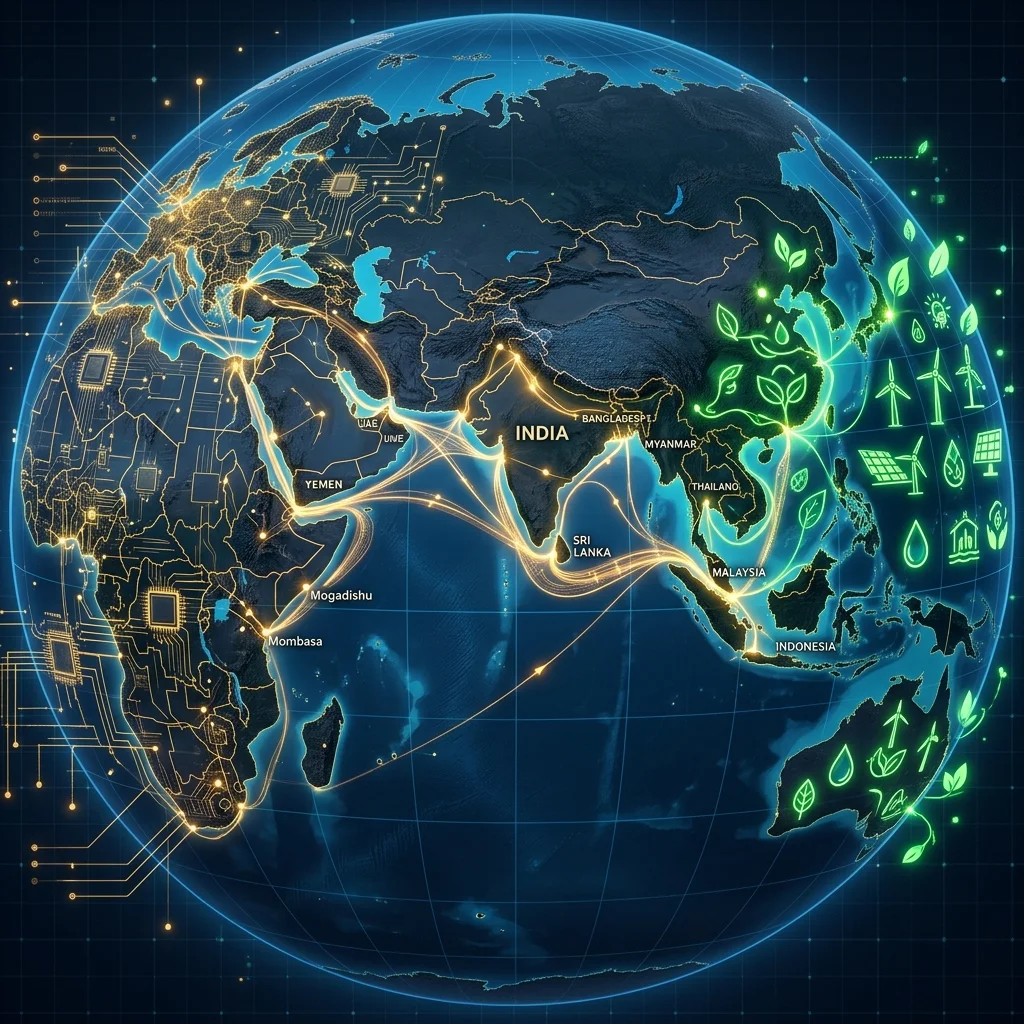
Global Trade 2026: South Asia’s Pivotal Role in a Slower, Greener, and More Fragmented World
Introduction: A Record High on Shaky Ground
Global trade reached an unprecedented milestone in 2025, surpassing $35 trillion with 7% year-on-year growth. Yet beneath this headline achievement lies a more sobering reality. The 2026 outlook projects global economic growth slowing to just 2.6%, with the United States contracting to 1.5% and China decelerating to 4.6% from 5% the previous year. These numbers signal that the era of easy trade expansion is giving way to something far more complex.
The forces reshaping global commerce are not merely cyclical. Rising tariffs, intensifying geopolitical tensions, and structural shifts in value chains are redefining how goods and services flow across borders. Services trade is surging ahead of goods. Environmental regulations are becoming binding trade rules. And the center of gravity in global commerce is tilting decisively toward the developing world.
For South Asia—home to some of the fastest-growing economies including India, Bangladesh, and Sri Lanka—these transformations create a dual-edged reality. Opportunities abound in services exports, green technology, and deepening South–South partnerships. Yet vulnerabilities from protectionism, digital exclusion, and critical mineral dependencies are equally real.
This article unpacks the hidden economic logic driving global trade in 2026 and examines what these shifts mean for a region poised to play an increasingly pivotal role.
[IMAGE: Line chart of global trade value 2020-2026 with projected slowdown annotation]
The Slowdown and Protectionist Headwinds
The numbers tell a cautionary tale. US GDP growth is projected at 1.5% in 2026, down from 1.8% in 2025. China’s economy, while still robust by global standards, is slowing to 4.6% from 5%. Weaker demand in these two largest economies inevitably pressures global trade volumes.
But the drag is not purely macroeconomic. Geopolitical tensions and rising tariffs are accelerating the reconfiguration of global value chains. The trend toward reshoring—bringing production back to home countries—and friend-shoring—moving supply chains to politically aligned nations—is reshaping investment flows. For South Asian exporters who have long relied on access to Western markets, this creates an unpredictable environment.
Regulatory complexity is adding another layer of friction. The WTO’s 14th Ministerial Conference, scheduled for 2026, will grapple with longstanding disputes over agricultural subsidies, fisheries, and e-commerce rules. Meanwhile, the European Union’s Carbon Border Adjustment Mechanism, set to begin full implementation in 2026, will impose new compliance costs on exporters—including those from South Asia. Countries like Bangladesh, which exports significant textiles and garments to Europe, face particular pressure to demonstrate environmental standards or risk losing market access.
Protectionism is not a temporary phenomenon. It reflects a deeper structural shift away from the rules-based, liberalized trade order that defined the post-Cold War era. For South Asia, navigating this fragmented landscape will require strategic agility.
[IMAGE: Map showing key tariff barriers and trade agreement zones in Asia-Pacific]
Services Trade Outpaces Goods – The Digital Divide Widens
While goods trade faces headwinds, services trade is accelerating. Services now account for 27% of global trade and grew 9% in 2025—nearly double the rate of goods trade. This shift matters profoundly for South Asia.
Digitally deliverable services—including software, IT support, business process outsourcing, and financial services—now make up 56% of global services exports. But the distribution is starkly uneven. In developed economies, digitally deliverable services account for 61% of total services exports. In least developed countries, that figure stands at only 16%.
South Asia presents a study in contrasts within this landscape. India, with its world-class IT sector and business services ecosystem, is exceptionally well-positioned. Indian services exports have consistently grown at double-digit rates, and the country has become a global hub for digital service delivery. However, neighboring economies like Bangladesh, Nepal, and Sri Lanka risk being left behind without significant investment in digital infrastructure, skills training, and regulatory frameworks that enable cross-border data flows.
The widening digital divide within South Asia itself is a pressing concern. If the region cannot bridge this gap, its less digitally advanced economies will become increasingly marginalized in the fastest-growing segment of global trade. For policymakers, this means prioritizing broadband connectivity, digital literacy, and data governance reforms as trade policy tools—not just domestic development objectives.
[IMAGE: Infographic comparing shares of digitally deliverable services by region (developed vs. LDCs vs. South Asia)]
South–South Trade: The Engine Redefining Global Commerce
Perhaps the most transformative shift in global trade is the rise of South–South commerce. Merchandise exports between developing countries surged from $0.5 trillion in 1995 to $6.8 trillion in 2025—an almost 14-fold increase. Today, 57% of developing-country exports go to other developing economies, up from just 38% three decades ago.
This is not a marginal trend. More than half of Africa’s exports now flow to other developing markets. Latin America, the Middle East, and Southeast Asia are all deepening their commercial ties. For South Asia, this reorientation offers a strategic buffer against the protectionist headwinds emanating from Western economies.
India’s trade with Africa is a case in point. It has doubled over the past decade, reaching over $100 billion. Indian pharmaceutical exports to Africa, agricultural machinery, and automotive components are increasingly competitive. Simultaneously, India has deepened its engagement with ASEAN nations, the Gulf states, and Latin America.
Intra-regional trade within South Asia itself, however, remains underdeveloped. South Asia accounts for only about 5% of global trade, and intra-regional trade constitutes a mere fraction of that. Political tensions between India and Pakistan, inadequate transport connectivity, and non-tariff barriers have historically constrained the region’s internal commerce. If South Asia could overcome these obstacles, the economic gains would be substantial.
South–South trade is not merely a safety valve against Western protectionism. It represents a fundamental reordering of global economic geography. For South Asian exporters, building relationships with fast-growing consumer markets in Africa, Southeast Asia, and the Middle East is not an alternative strategy—it is becoming the main game.
[IMAGE: Flow map showing trade routes from South Asia to Africa, Southeast Asia, and the Middle East with data callouts]
Green Trade, Critical Minerals, and New Regulatory Frontiers
The green transition is reshaping global trade in ways that create both opportunities and dependencies. The clean energy sector—solar panels, wind turbines, electric vehicles, and battery storage—is one of the fastest-growing segments of international trade. China dominates production, but developing countries are increasingly seeking to capture more value in these supply chains.
For South Asia, the critical minerals dimension is particularly significant. The region holds substantial reserves of graphite, rare earth elements, and lithium—materials essential for batteries and renewable energy technologies. Sri Lanka’s graphite deposits and India’s rare earth reserves are increasingly strategic assets in the global clean energy race.
However, the concentration of processing capacity poses risks. Over 90% of the world’s rare earth processing is controlled by China. This dependency creates vulnerabilities not just for importing nations but also for countries that export raw materials without capturing downstream value. South Asian nations face a choice: remain raw material suppliers or invest in domestic processing and manufacturing capacity to capture higher-value segments of the green supply chain.
Environmental regulations are also becoming trade rules. The EU’s Carbon Border Adjustment Mechanism, the US Inflation Reduction Act’s clean energy provisions, and emerging disclosure requirements for supply chain emissions are creating new compliance landscapes. For South Asian exporters, particularly in textiles, apparel, and light manufacturing, demonstrating environmental compliance is no longer optional—it is a condition of market access.
The UNCTAD Trade Outlook for 2026 emphasizes that environmental policy coherence will be crucial for developing countries. Without targeted technical assistance and financing, green trade rules risk becoming a new form of protectionism that disadvantages the very economies most vulnerable to climate change.
[IMAGE: Diagram showing critical mineral supply chains from extraction to processing to end-use, with South Asian countries highlighted]
South Asia at the Crossroads: Opportunities and Vulnerabilities
The convergence of these trends places South Asia at a strategic crossroads. The region’s demographic dividend, growing middle class, and expanding digital infrastructure position it to benefit from multiple global shifts.
In services trade, India’s continued dominance provides a powerful anchor. The country’s IT exports alone exceed $200 billion annually, and its fintech, edtech, and health-tech sectors are increasingly global in scope. For Bangladesh and Sri Lanka, opportunities exist in IT-enabled services, digital freelancing, and business process outsourcing—but only if digital infrastructure and skills training are prioritized.
In South–South trade, the region’s geographic position linking South Asia, Southeast Asia, and the Middle East offers unique advantages. India’s trade agreements with ASEAN, the UAE, and African nations provide templates for deeper integration. The challenge is translating these bilateral arrangements into a coherent regional trade strategy.
The green transition presents both an opportunity and a risk. South Asia’s critical mineral reserves are increasingly valuable, but without processing capacity, the region risks remaining a supplier of raw inputs. Similarly, the shift toward sustainable manufacturing could disadvantage unregulated producers while rewarding those who invest in cleaner production methods.
Yet the vulnerabilities are equally real. Protectionism in Western markets could disrupt traditional export sectors like garments and textiles. The digital divide within South Asia could leave poorer countries behind. And the region’s energy dependence—particularly on imported fossil fuels—creates macroeconomic fragility.
The UNCTAD trade outlook underscores a fundamental point: the global trade regime is becoming more fragmented, more regulated, and more contested. For South Asia, the path forward requires strategic diversification—of markets, of sectors, and of capabilities.
[IMAGE: Infographic showing South Asia's trade composition by sector, compared to global averages]
Conclusion: Navigating Fragmentation with Strategic Clarity
The record-breaking trade volumes of 2025 marked a high point that is unlikely to be sustained in the same form. The global economy in 2026 is slower, greener, and more fragmented. Tariffs are rising, supply chains are being reconfigured, and environmental regulations are reshaping competitive dynamics.
For South Asia, these shifts are not abstract trends. They are concrete realities affecting exports, investment, and economic development strategies. The region’s ability to navigate this complex landscape will depend on three priorities.
First, deepening South–South connections. Intra-regional trade within South Asia and partnerships with Africa, Southeast Asia, and the Middle East offer a buffer against Western protectionism and access to the fastest-growing consumer markets in the world.
Second, bridging the digital divide. Without significant investment in digital infrastructure and skills, the region’s less developed economies will be locked out of the fastest-growing segment of global trade—digitally deliverable services.
Third, capturing value in the green transition. Critical mineral reserves are an asset, but processing and manufacturing capacity will determine whether that asset translates into sustainable economic development or remains a raw material dependency.
Global trade in 2026 is not declining. It is transforming. For South Asia, the question is not whether to engage with these changes but how to do so with strategic clarity. The region that succeeds will be the one that treats fragmentation not as a threat to be managed but as an opportunity to be seized.