From Services to Products: How South Asia''s Mobile-First Infrastructure is
South Asia is undergoing a structural economic shift from its legacy IT services
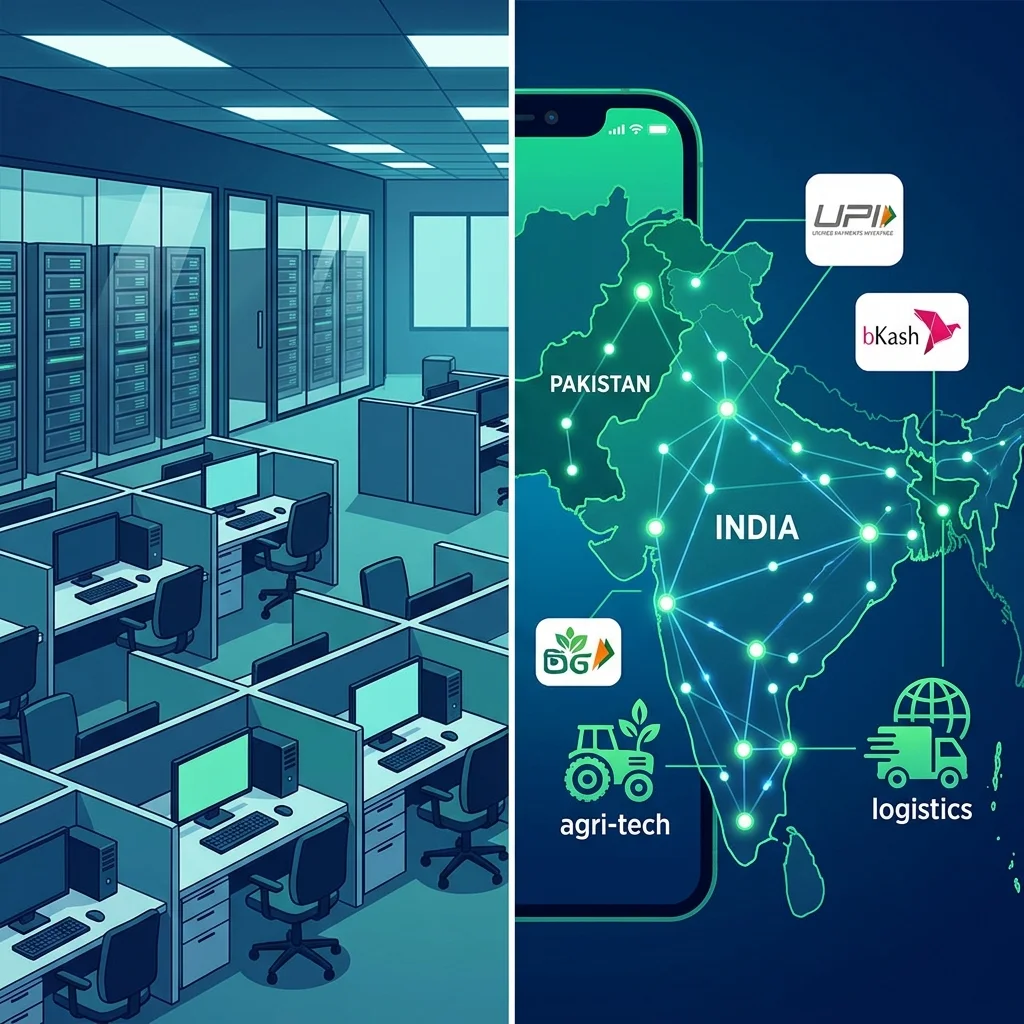
From Services to Products: How South Asia's Mobile-First Infrastructure is Driving a Tech Innovation Revolution
For decades, South Asia’s technology story was synonymous with IT services—call centers, back-office processing, and outsourcing contracts from Fortune 500 firms. India alone exported over $245 billion in IT services in 2023, accounting for nearly 60% of its software exports. But a quieter, more structural transformation has been unfolding beneath the surface. Venture capital is flowing into intellectual-property-intensive startups at an unprecedented rate, mobile-first digital infrastructure is becoming the new standard, and a new generation of founders is betting on product-led models rather than billing by the hour.
This shift is not just a narrative of “startup culture”; it represents a fundamental reallocation of capital, talent, and infrastructure across India, Bangladesh, and Pakistan. For global investors and supply-chain strategists, understanding the hidden logic of this transition is essential to capturing the next wave of South Asian technology innovation.
---
The Great Reallocation: Capital Shifts from Services to IP-Intensive Startups
Venture capital deployment in South Asian tech enterprises grew at an 18% compound annual growth rate (CAGR) from 2018 to 2023, outpacing both Southeast Asia and Latin America, according to GPCA data. While legacy IT services firms remain profitable and large—India’s IT sector still employs over 5 million people—the net new capital is flowing elsewhere.
The share of private capital directed into IP-intensive startups jumped from 12% to 31% of total venture deployment between 2019 and 2023. In absolute terms, this represents approximately $4.2 billion per year being redeployed from service-oriented models to product-led enterprises. These are companies building proprietary technology—software platforms, algorithms, patented hardware designs—rather than offering commoditized labor.
[IMAGE: Line chart showing the rising share of IP-intensive startup investment vs. services from 2019 to 2023, with annotations from GPCA.]
Several forces are driving this reallocation. First, product-led enterprises command 2–3x higher revenue multiples than service firms in comparable markets, incentivizing entrepreneurs to build for scale rather than margins. Second, the cost of building digital products has plummeted due to cloud infrastructure, open-source tools, and widely available mobile SDKs. Third, a growing base of serial entrepreneurs who once built outsourcing firms are now pivoting to platform businesses, bringing operational discipline with them.
The implications are significant. South Asia’s economic model has long relied on exporting services to global clients, tying its growth to discretionary corporate IT budgets. A product-led economy, by contrast, generates recurring revenue, captures higher value-add, and can scale across borders with lower incremental cost. The region is at a turning point: services still dominate the GDP contribution, but the growth engine has already shifted to IP and platforms.
---
Mobile-First as the Operating System: UPI, bKash, and the Infrastructure Layer
If the capital reallocation is the fuel, mobile-first digital infrastructure is the engine. South Asia is home to 1.8 billion people with mobile penetration exceeding 85% of adults, while desktop internet access remains below 30%. For the vast majority, the smartphone is the only digital interface—and that reality has shaped product innovation in a fundamentally different way from the desktop-centric models of the West.
The most powerful example is India’s Unified Payments Interface (UPI), which processed 117 billion transactions worth $2.1 trillion in fiscal year 2024. Bangladesh’s mobile financial services (MFS) ecosystem—led by bKash and Nagad—has grown to over 180 million registered accounts, handling $1.2 billion in daily transactions. These real-time payment backbones have become the operating system on which product startups build. They enable instant payments, credit scoring, escrow, and settlement—all within a mobile app.
[IMAGE: Infographic showing mobile phone icons with UPI, bKash, Nagad logos connected by arrows to a map of India and Bangladesh, with transaction volume bubbles.]
This mobile-first fintech infrastructure has unlocked massive product innovation beyond payments. Digital lending platforms disbursed $65 billion between 2020 and 2024, with a non-performing loan ratio of just 3.2%—lower than many traditional banks. These platforms use alternative data (transaction history, bill payments, social behavior) to underwrite credit for small merchants, farmers, and logistics operators who were previously invisible to the formal banking system. In 2023 alone, fintech infrastructure attracted $3.8 billion in private capital, split across credit (48%), payments (32%), and insurance (20%), according to GPCA’s Fintech Infrastructure Review.
The critical insight is that South Asia’s mobile-first infrastructure is not merely a digitized version of existing services—it is a platform for entirely new product categories. Insurance products are embedded into ride-hailing apps. Working capital loans are offered at checkout on e-commerce platforms. Savings products are bundled with messaging apps. This embedding of financial products into everyday mobile apps is a hallmark of the product-led transformation.
---
Agriculture and Logistics: The Underappreciated Product Innovation
While fintech grabs headlines, some of the most impactful product-led innovation is happening in agriculture and logistics—two sectors that have long been characterized by extreme fragmentation. In India, 85% of farms are under two hectares in size, and 85% of trucks are owner-operated. These are not the kind of concentrated industries where traditional enterprise software thrives; they require mobile-native, highly localized product platforms.
DeHaat in India and iFarmer in Bangladesh exemplify this trend. DeHaat has integrated 2.5 million farmers into its platform, offering AI-driven demand forecasting, blockchain-based provenance tracking, and direct access to buyers. iFarmer has onboarded 200,000 smallholder farmers, enabling them to access crop insurance, high-quality inputs, and fair-market pricing through a mobile app. Both companies have built proprietary IP around supply-chain optimization, weather modeling, and credit scoring for the agricultural segment.
[IMAGE: Split visual showing a farmer using a smartphone in a rice paddy on one side, and a logistics dashboard with AI route optimization on the other, with data flow nodes connecting to South Asian map.]
Logistics technology has seen an even sharper acceleration. Private capital into logistics tech startups surged from $480 million in 2019 to $1.9 billion in 2023, powering platforms like TruckBhejo, Porter, and Shiprocket. These companies are not just aggregating capacity—they are building proprietary routing algorithms, real-time inventory management systems, and automated payment reconciliation tools. The fragmented nature of South Asia’s logistics sector means that a product-led platform can capture massive inefficiencies: empty truck miles, inconsistent delivery times, and opaque pricing.
The agricultural and logistics stories underscore a broader point: South Asia’s product-led transformation is not limited to consumer internet or fintech. It is penetrating deeply into the “real economy” sectors that employ the majority of the region’s population. And because these sectors are so fragmented, the first product platform to achieve critical mass can create a durable competitive moat.
---
What This Means for Global Investors and Supply Chains
The product-led economic transformation in South Asia carries implications that extend well beyond the region. For global investors, the growing concentration of IP-intensive startups—particularly in agri-tech, logistics, and fintech—offers diversification from traditional Indian IT services and Chinese tech giants. Venture capital South Asia has become a distinct asset class, with risk-return profiles that differ from both Silicon Valley and Southeast Asia.
For global supply chains, the rise of mobile-first logistics platforms in India and Bangladesh means that the cost and reliability of moving goods in the region is improving rapidly. Real-time tracking, automated payments, and AI-optimized routing reduce friction for importers and exporters. As multinational companies seek to diversify their manufacturing bases away from China, South Asia’s improving logistics infrastructure—enabled by product startups—makes it a more viable alternative.
Finally, the talent angle deserves attention. The reallocation of capital toward product-led models is pulling top engineering talent away from services firms, creating a virtuous cycle. Engineers who once wrote code for foreign clients are now building proprietary products for local and global markets. This “brain gain” within the region is perhaps the most durable driver of South Asia technology innovation trends.
The shift from services to products is neither complete nor uncontested. Legacy IT services firms are investing in their own IP and platforms. Regulatory hurdles, especially in data localization and cross-border payments, remain significant. But the direction is clear. Mobile-first infrastructure, glut of venture capital, and a new generation of founders are rewriting the region’s economic narrative. South Asia is no longer just the world’s back office—it is building the front office of the future.