The Trust Paradox: How Emerging Technologies Are Reshaping Business Innovation
From AR boosting retail conversions by 90% to devastating data breaches
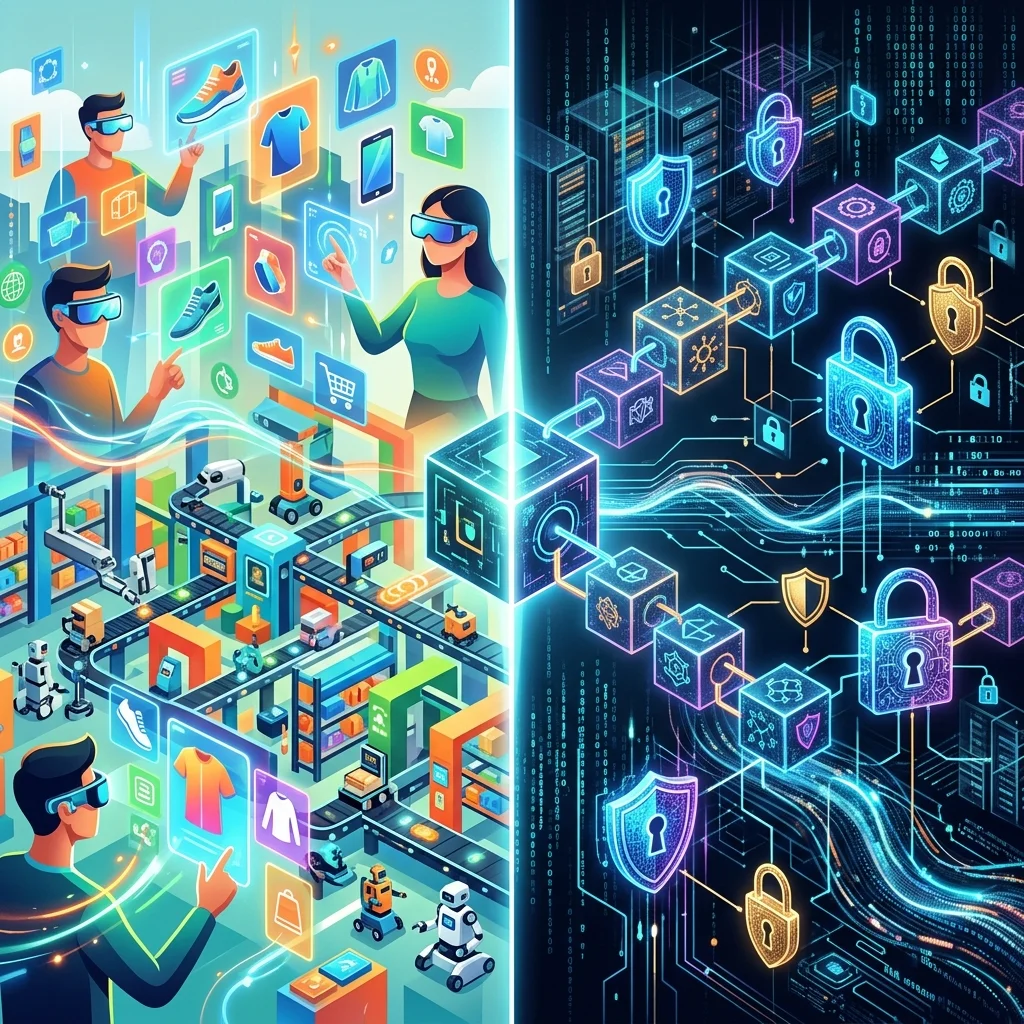
The Trust Paradox: How Emerging Technologies Are Reshaping Business Innovation and Security
The rapid adoption of augmented reality (AR), artificial intelligence (AI), blockchain, and the Internet of Things (IoT) is simultaneously unlocking unprecedented growth opportunities and exposing companies to new, often costly vulnerabilities. For every 90% conversion lift delivered by an AR shopping tool, there is a data breach affecting millions of records—like the 2019 First American leak that exposed over 800 million sensitive documents. This dynamic has created a “trust paradox”: firms must race to deploy innovative customer-facing technologies while simultaneously securing backend systems against increasingly sophisticated threats.
[IMAGE: Split-screen image: left side shows vibrant AR retail scene, right side shows a hacker silhouette over servers]
The economic logic behind this paradox is both simple and demanding. Revenue-generating innovations—AR try-ons, AI chatbots, immersive brand experiences—drive customer engagement and sales. But those same technologies generate vast new data streams that, if unprotected, become liabilities. Meanwhile, internal transformation tools like IoT sensors, blockchain ledgers, and autonomous logistics systems promise efficiency gains, but also widen the attack surface. The emerging technology business impact is therefore a balancing act: companies that master this dual challenge turn security into a competitive differentiator rather than a cost center.
This article draws on industry data, high-profile breach incidents, and forward-looking strategies across AR/VR, AI-powered chatbots, IoT, blockchain, and synthetic data. It reveals a fundamental shift in which privacy compliance and cybersecurity measures are no longer just regulatory checkboxes, but central pillars of business resilience.
---
Customer Engagement Revolution: AR, AI, and Immersive Experiences
Retailers that adopted AR early have seen remarkable returns. Since 2020, brands using AR-powered virtual try-ons report a 20% surge in engagement rates and a 90% increase in conversions. Adidas, for example, deployed an AR shoe try-on tool that lets customers visualize sneakers on their own feet via a smartphone camera, significantly reducing return rates. Wayfair’s “View in Room” AR feature enables shoppers to see how furniture fits in their actual living spaces, driving confidence and purchase intent. Lowe’s introduced LoweBot, an AI-powered in-store robot that helps customers locate products—merging AI chatbot convenience with physical retail.
[IMAGE: Person using smartphone AR to visualize a shoe on their foot in a living room setting]
Beyond individual transactions, immersive experiences are reshaping long-term brand loyalty. Disney’s Imagineers have developed gamified AR park experiences that overlay digital characters and quests onto physical environments, increasing dwell time and repeat visits. The company’s $1.5 billion investment in Epic Games, creator of Fortnite, signals a strategic pivot toward a “persistent universe” where brand interaction extends far beyond a single purchase. Such moves illustrate how AR retail conversions are not isolated metrics—they are gateways to deeper customer relationships.
AI-powered chatbots have become equally integral. Natural language processing (NLP) models, from GPT-based assistants to specialized retail bots, provide instant support, personalized product recommendations, and seamless checkout. Industry data suggests that businesses using AI chatbots see a 30–40% reduction in customer service costs while improving response times. However, these chatbots also collect vast amounts of conversational data—names, addresses, payment details, and preferences—creating a tension between personalization and privacy.
---
Supply Chain Transformation: From AI Forecasting to Autonomous Trucks
The backend of modern commerce is undergoing a parallel revolution. According to a McKinsey survey, 43% of merchants plan to integrate AI and machine learning into planning processes within the next three years. AI forecasting algorithms analyze historical sales, weather patterns, and social media trends to optimize inventory levels, reducing waste and stockouts.
IoT sensors are the nervous system of this transformation. Attached to pallets, containers, and machinery, they provide real-time data on location, temperature, humidity, and shock, enabling proactive maintenance and cold-chain integrity. In food and pharmaceutical supply chains, this visibility is critical for compliance and safety.
[IMAGE: Autonomous truck on a highway with a digital overlay showing real-time inventory data flow]
Autonomous trucks and warehouse robotics are scaling rapidly. Companies like TuSimple and Waymo Via have tested self-driving trucks for long-haul routes, while Amazon, Walmart, and others deploy hundreds of autonomous robots in fulfillment centers. For last-mile delivery, sidewalk robots and drone programs are beginning to reduce labor costs and delivery times. The economic case is strong: autonomous logistics can cut per-mile costs by up to 30% and error rates by over 50%.
Blockchain technology adds a layer of tamper-proof transparency. In supply chain management, blockchain creates an immutable record of every transaction—from raw material sourcing to final delivery. This provenance tracking is especially valuable for industries where authenticity matters, such as luxury goods, pharmaceuticals, and organic foods. For example, Walmart uses blockchain to trace mangoes from farm to store in seconds instead of days, improving recall efficiency and consumer trust. The convergence of supply chain AI robotics with blockchain creates a system that is both agile and trustworthy.
---
The Rising Threat Landscape: Data Breaches and Privacy Challenges
Yet every technological advance introduces a new vector for attack. In 2021, hackers breached Microsoft Exchange Server, exploiting four zero-day vulnerabilities to access email accounts across thousands of organizations. The attack exposed sensitive corporate email data and forced Microsoft to issue emergency patches. It remains one of the most widespread cyberattacks in history, highlighting how even the largest tech firms are vulnerable.
Similarly, the 2019 First American Corporation data leak—which exposed over 800 million documents, including bank account numbers and Social Security numbers—stemmed from a simple design flaw in the company’s website authentication system. The breach cost the company millions in settlements and regulatory fines, and severely damaged customer trust.
These incidents underscore a growing need for privacy compliance solutions. One emerging tool is the data clean room (DCR). DCRs allow businesses to analyze customer data and execute targeted advertising without directly sharing personally identifiable information (PII). They are especially valuable for companies operating under GDPR and CCPA, as they enable cross-platform insights while maintaining legal boundaries. However, DCRs have a tradeoff: aggregation and anonymization reduce output accuracy, potentially lowering ad performance by 10–20%. Companies must weigh compliance against campaign effectiveness.
[IMAGE: Glowing digital padlock partially dissolved into binary code]
An alternative approach gaining traction is synthetic data. First developed for statistical modeling in the 1980s, synthetic data uses generative algorithms to create artificial datasets that mirror real-world patterns without containing any actual personal information. Financial institutions, healthcare providers, and tech companies now use synthetic data for product testing, AI model training, and fraud detection—all while sidestepping privacy risks. The global synthetic data market is projected to reach $1.4 billion by 2028, driven largely by the need to comply with GDPR and CCPA without sacrificing innovation.
---
Zero Trust Architecture: The New Security Baseline
In response to this evolving threat landscape, organizations are increasingly adopting zero trust architecture. Unlike traditional perimeter-based security—which assumes everything inside the corporate network is safe—zero trust operates on the principle “never trust, always verify.” Every user, device, and application must authenticate continuously, regardless of location.
The core components of zero trust include micro-segmentation (dividing networks into small zones), multifactor authentication (MFA), and least-privilege access policies. When combined with blockchain-based identity management, zero trust becomes even more resilient: blockchain can store decentralized, tamper-proof identity credentials that reduce reliance on vulnerable centralized databases.
Major adopters include Google, which implemented its BeyondCorp zero trust model after the 2009 Aurora attack, and Microsoft, which now mandates zero trust across all internal systems. For small and medium enterprises, managed zero trust services are lowering the barrier to entry, making advanced security accessible without massive IT budgets.
---
Innovation as Trust Builder: Disney, Adidas, and the Path Forward
The companies that most effectively navigate the trust paradox are those that treat security not as a brake on innovation, but as an accelerator. Disney, for instance, has invested heavily in both immersive AR and zero trust data protection. Its MagicBand+ wearable—which stores guest preferences, payment info, and park entry data—uses end-to-end encryption and is designed to be as secure as it is convenient. The result: a seamless, personalized experience that customers trust with their personal information.
Adidas similarly combines AR-driven shopping with robust cybersecurity zero trust blockchain systems for its supply chain. By tracing sneaker production from factory to store on a blockchain, Adidas can verify authenticity (combating counterfeits) while also ensuring that supplier data remains encrypted and auditable. This dual focus on customer-facing excitement and backend integrity creates a brand reputation that is both innovative and trustworthy.
Emerging research from Harvard Business School suggests that companies that prioritize data security see a 6–12% premium in customer willingness to pay. In other words, trust has become a monetizable asset.
---
Conclusion: Balancing Innovation and Trust
The trust paradox is not a temporary challenge—it is the defining business tension of the next decade. As AR retail conversions continue to climb, as AI chatbots become more conversational, and as autonomous trucks reshape logistics, the same technologies must be designed with privacy and security embedded from the start.
The path forward involves three strategic shifts:
- Integrate security into product design (secure-by-design), not as an afterthought.
- Adopt privacy-preserving technologies like data clean rooms and synthetic data to enable analytics without exposure.
- Implement zero trust architecture as a non-negotiable foundation for all digital operations.
Companies like Disney, Adidas, and forward-thinking retailers have already demonstrated that trust and innovation are not oppositional. When done right, security ceases to be a cost center and becomes a competitive moat. The future belongs to those who can embrace the paradox—using emerging technologies to grow while earning the trust their customers deserve.