Agentic AI in ASEAN: How Localized Agents Are Driving Digital Transformation
As ASEAN businesses race toward becoming agentic enterprises in 2026, a new
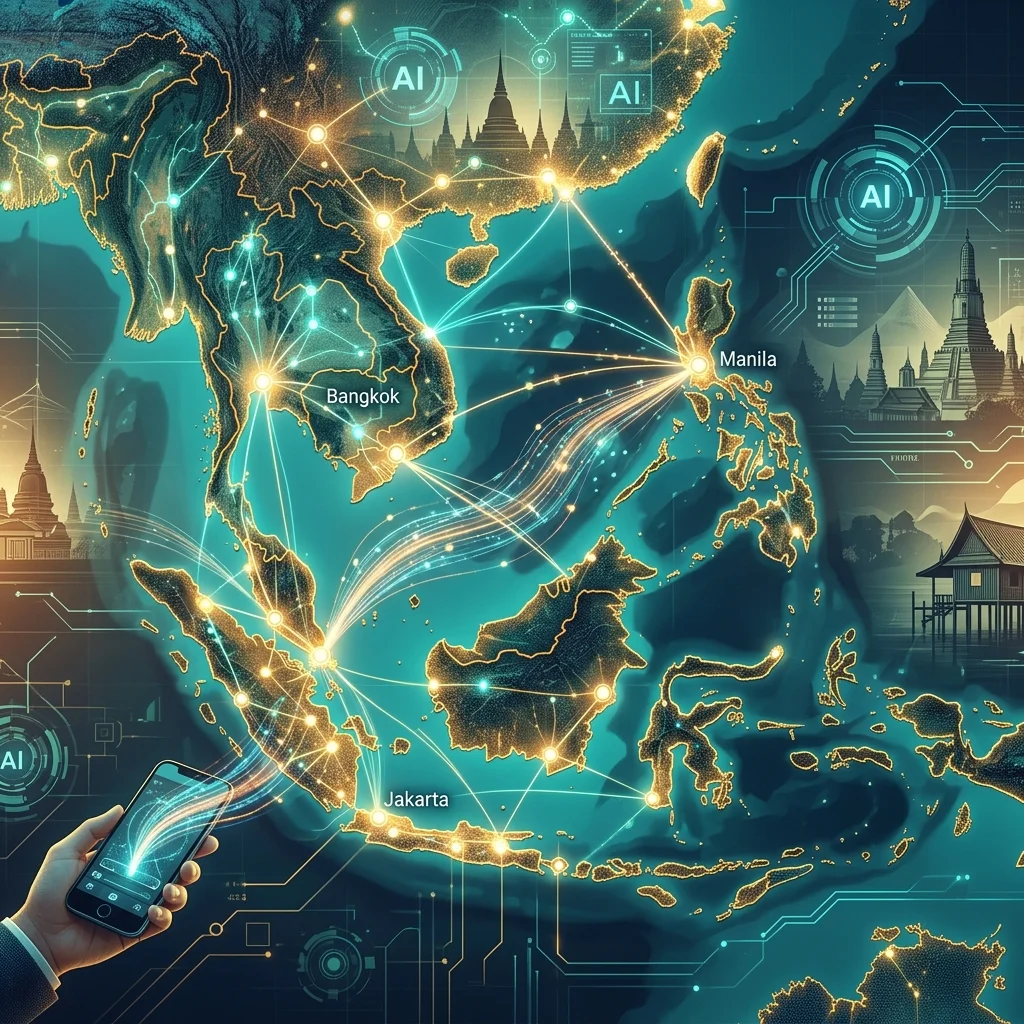
Agentic AI in ASEAN: How Localized Agents Are Driving Digital Transformation and Financial Inclusion in 2026
The Dawn of the Agentic Enterprise in ASEAN
By early 2026, the conversation around artificial intelligence in Southeast Asia has shifted decisively from experimentation to execution. Businesses across the Association of Southeast Asian Nations (ASEAN) are no longer asking whether they should deploy AI agents — they are asking how to deploy them at scale, across languages, and into the hands of workers and consumers who have long been underserved by traditional digital infrastructure.
The data is striking. According to Salesforce’s latest regional report, agent creation across ASEAN surged 119% in the first half of 2025 alone. Monthly employee-agent interactions climbed 65% during the same period, signaling that these are not isolated pilot projects but production-grade transformations taking root in Indonesia, the Philippines, Thailand, Vietnam, and Malaysia. The same report shows that companies using AI agents in customer service recorded a 46% higher customer satisfaction score compared to those relying solely on human agents or rule-based chatbots.
Six underlying trends, identified by Salesforce ASEAN’s research, are shaping this shift: localized AI, rapid experimentation, voice-enabled agents, personal AI assistants, human orchestration, and ambient intelligence. Together, they are rewriting the rules of digital transformation for a region that is home to 680 million people, hundreds of languages, and some of the world’s fastest-growing digital economies.
[IMAGE: Infographic showing the growth curve of agent deployment from H1 2025, with ASEAN flags overlaid on the trend line. Data points: 119% agent creation growth, 65% interaction increase, 46% higher CSAT.]
Trend 1: Localized AI – Small Language Models Win Big
One of the most critical drivers of agentic AI adoption in ASEAN is localization. Generic large language models (LLMs) perform poorly in the region’s linguistically fragmented landscape. Tagalog, Thai, Vietnamese, Bahasa Melayu, and Bahasa Indonesia each have grammatical structures, cultural references, and colloquialisms that English-centric models cannot handle reliably. Moreover, many regional dialects and low-resource languages lack sufficient training data for mainstream LLMs.
Salesforce responded by localizing its Agentforce platform into five ASEAN languages in late 2025 — a move that analysts say will become a template for the industry. The key insight is that Small Language Models (SLMs), which are purpose-built for specific languages and tasks, offer a pragmatic alternative. They are cheaper to train and run, faster in inference, and far more culturally attuned.
The financial inclusion implications are profound. In Indonesia, approximately 25% of adults remain underbanked, according to World Bank data. Many live in rural areas where physical bank branches are absent, and digital banking apps are either unavailable or require English proficiency. A localized AI agent, delivered through a simple smartphone interface and speaking in colloquial Bahasa Indonesia, can offer credit scoring based on alternative data, provide financial advice, and guide users through loan applications — without requiring literacy in English or formal financial jargon.
One Indonesian fintech startup, partnering with a major telecom provider, launched a voice-based agent in early 2026 that has already onboarded over 200,000 previously unbanked users. The agent assesses creditworthiness by analyzing mobile top-up patterns, bill payment history, and peer-to-peer transaction data, then provides microloans of $50–200 entirely through voice interaction in local dialects.
[IMAGE: A split-screen image: left side shows a farmer in rural Indonesia using a voice-enabled AI agent on a phone in a local language; right side shows a data center with labeled 'SLM' chips. No text or watermark.]
Trend 2 & 3: Experimentation to Scale – Voice-Enabled Agents as the On-Ramp
The second and third trends — widespread experimentation and voice-enabled agents — are closely linked. Across ASEAN, businesses of all sizes are moving past the "let's try a chatbot" phase. Salesforce data shows that 94% of customers who encountered an AI agent in a chat window actively engaged with it, a signal that the technology has crossed the trust threshold for most users.
Voice agents lower the participation barrier even further. In markets like the Philippines and Indonesia, where smartphone penetration exceeds 70% but desktop usage remains low, voice is the natural interface. For micro, small, and medium enterprises (MSMEs) — which account for 99% of all Philippine businesses — voice-enabled agents are a lifeline. A sari-sari store owner in Manila can dictate inventory updates or ask for loan terms simply by speaking into a mobile app, bypassing the need for a dedicated IT team or even formal typing skills.
This aligns with the "personal agents" trend: each employee or consumer can now have a dedicated AI co-pilot that learns their preferences over time. In early 2026, a Thai e-commerce logistics firm deployed personal agents for its 5,000 delivery drivers. The agents handle route optimization, customer queries, and real-time package tracking through voice commands, freeing drivers to focus on service. Driver satisfaction rose 38%, and on-time delivery rates improved by 12% within three months.
The combination of voice and personalization is proving especially powerful for financial services. In Vietnam, a bank launched an agent that provides personalized savings advice via voice. The agent analyzes a user’s spending habits and goals, then suggests micro-investment plans — all in Vietnamese with regional accent recognition.
[IMAGE: Visual of a busy Philippine market with a shopkeeper speaking to an AI agent on a tablet; caption on image area: 'Voice + Agent = New Frontline'. No text overlay.]
Trend 4 & 5: Personal Agents and Human Orchestration – The Symbiosis
As agents become personal, the relationship between AI and human workers is evolving from replacement to orchestration. The fourth trend — personal agents — creates dedicated assistants that handle routine tasks: scheduling, FAQ responses, order status checks, and basic data entry. The fifth trend — human orchestration — ensures that humans remain central when complexity rises.
The data supports this symbiotic model. Salesforce’s report finds that 71% of service representatives who use AI agents report genuine growth in their problem-solving skills. Instead of being bogged down by repetitive queries, human agents focus on nuanced issues — complex complaints, cross-departmental coordination, high-value negotiations — where empathy and judgment are irreplaceable.
In Malaysia, a major insurance company introduced personal agents for its claims handlers. The agents automatically pre-fill claim forms, verify documents against policy terms, and flag potential fraud indicators. Human handlers review the output, make discretionary decisions, and handle customer appeals. The result: average claim processing time dropped from 5 days to 36 hours, while customer satisfaction climbed 28%. Crucially, employee turnover among claims staff fell 15%, as workers reported feeling more empowered rather than automated.
This orchestration model is also spreading to consumer-facing applications. In Singapore, a retail bank launched a "financial health agent" that customers can interact with via voice or text. The agent handles routine balance inquiries, transaction history, and budget tracking. But when a customer asks about restructuring a mortgage or applying for a large loan, the agent seamlessly transfers the conversation to a human banker who already has the context. The transition is so smooth that 82% of customers said they did not notice the switch until after the call.
[IMAGE: Diagram showing a split workflow: left side 'AI Agent' handles routine tasks (FAQ, scheduling, data entry), right side 'Human Agent' handles complex cases (negotiations, complaints, high-value). Connecting arrows showing 'escalation with context'.]
Trend 6: Ambient AI – The Unseen Enabler
The sixth and most forward-looking trend is ambient AI — agents that operate in the background, making decisions and triggering actions without requiring explicit user input. In ASEAN’s rapidly urbanizing economies, this is taking shape in logistics, agriculture, and energy management.
A Singapore-based logistics company, for example, uses ambient agents to monitor warehouse inventory, weather patterns, and delivery truck performance in real time. The agents automatically reroute shipments when traffic is congested, reorder stock when thresholds are breached, and even negotiate last-mile delivery pricing with independent drivers — all without human intervention unless an exception occurs. The company reports a 22% reduction in logistics costs and 18% faster delivery times.
In Thai agriculture, ambient agents are being deployed to monitor soil moisture, crop health, and pest activity via IoT sensors. The agents send alerts and recommendations to farmers via their phones in Thai dialect, but they also autonomously adjust irrigation systems and trigger drone-based pesticide spraying. Early adopters have seen yield improvements of 15–20% while reducing water usage by 30%.
The economic logic is clear: ambient AI solves the region’s chronic challenge of scale. With limited human capital and fragmented infrastructure automating low-level decisions, businesses can grow without proportionally increasing headcount. For underbanked populations and MSMEs, this means access to services that were previously only available to large corporations.
[IMAGE: Illustration of a smart farm in Thailand with icons representing soil sensors, drone, and a farmer's smartphone connected to a central 'Ambient AI' node. Subtle data streams. No text.]
The Hidden Economic Logic of Agentic AI in Southeast Asia
Behind these trends lies a deeper economic argument. ASEAN is not a single market; it is a patchwork of economies at different stages of development. Agentic AI, when properly localized, allows businesses to leapfrog legacy infrastructure that has long hindered digital transformation. Voice-enabled agents bypass literacy barriers. Small language models avoid the cost and latency of large models. Personal agents reduce training overhead for a workforce that is mobile-first and often informal.
For financial inclusion, the impact is measurable. The 25% of underbanked adults in Indonesia, the unbanked MSMEs in the Philippines, and the rural farmers in Vietnam and Thailand represent a massive latent market. Agentic AI — deployed via voice, localized to dialects, and embedded in everyday apps — is the most scalable tool yet to bring them into the formal economy.
Salesforce’s data underscores the momentum. With a 119% surge in agent deployment and 46% higher customer satisfaction, the early evidence suggests that 2026 is the year ASEAN’s agentic enterprise becomes mainstream. No longer a futuristic concept, it is a practical, proven engine for growth — one that speaks the region’s languages, understands its cultures, and serves its most neglected consumers.
[IMAGE: Map of Southeast Asia with glowing nodes in Jakarta, Manila, Bangkok, Hanoi, Singapore, and Kuala Lumpur. Light trails connecting to rural areas. Teal, gold, deep blue palette. No text.]