Southeast Asia E-commerce Market Forecasts 2030: The Hidden Infrastructure
Southeast Asia's internet economy is set to surge from $194 billion to over
Southeast Asia E-commerce Market Forecasts 2030: The Hidden Infrastructure Race Behind the Growth
Introduction: The Big Picture – Southeast Asia’s Internet Economy Boom
Southeast Asia’s digital economy is entering a phase of explosive expansion that few regions can match. According to Google, Temasek, and Bain & Company’s e-Conomy SEA report, the region’s total internet economy is forecast to grow from approximately USD $194 billion in 2023 to over USD $330 billion by 2025. This represents a compound annual growth rate nearing 30%, driven by a young, mobile-first population and rapidly improving digital infrastructure.
Within this broad trajectory, individual markets show stark differences in pace and scale. Indonesia, already the region’s largest internet economy at more than USD $82 billion in 2023, continues to dominate. But the real story lies in the second-tier markets: Vietnam, Thailand, and the Philippines are each expected to more than double their ecommerce market values by 2030. Vietnam’s ecommerce sector, for instance, has been expanding at over 20% year-on-year, buoyed by rising smartphone penetration and a growing middle class.
[IMAGE: Bar chart showing current and projected internet economy values for key SEA countries (2023–2025/2030), with Indonesia, Vietnam, Thailand, Philippines, Malaysia, and Singapore labeled.]
Yet headline numbers only tell part of the tale. Beneath the surface, a complex and often fragmented infrastructure landscape is shaping which countries will actually capture this growth. The winners in Southeast Asia’s ecommerce boom through the end of the decade will be determined not just by consumer demand, but by the readiness of cross-border trade systems, the maturity of digital payment rails, and the efficiency of logistics networks.
---
Cross-Border Ecommerce Readiness: The Index Reveals a Divided Region
To understand where opportunities and bottlenecks lie, analysts increasingly turn to cross-border ecommerce development indexes. One widely cited framework, published by the China International Electronic Commerce Center and other institutions, ranks Asia-Pacific economies on a composite score that accounts for logistics infrastructure, customs efficiency, digital payment integration, platform sophistication, and regulatory alignment.
The latest data reveals a clear hierarchy. China leads the region with a score of 71.4, followed by South Korea at 66.7 and Singapore at 65.5. These top-tier markets boast highly automated customs procedures, dense warehousing networks, and mature digital payment ecosystems. Japan (61.1), Thailand (58.8), Malaysia (57.7), and Indonesia (54.3) occupy the middle band, while markets like the Philippines, Vietnam, and Myanmar rank lower due to gaps in last-mile delivery, payment fragmentation, and customs digitization.
[IMAGE: Heat map or table of cross-border ecommerce development index scores for selected Asia-Pacific countries, with color gradients from dark green (high) to red (low).]
What do these scores mean in practice? For a consumer in Bangkok ordering from a cross-border platform, a high index score translates to faster delivery times, lower import duties friction, and seamless payment conversion. For a seller in Jakarta trying to export to Malaysia, a lower score means higher compliance costs, longer clearance delays, and greater risk of package loss or damage.
The implications for investment are significant. Venture capital and logistics providers are increasingly allocating capital to markets where infrastructure improvements can unlock the greatest marginal gains. Thailand, with its relatively strong score of 58.8 and strategic location as a regional hub, has attracted billions in warehouse and fulfillment center investments from firms like Alibaba, JD.com, and local players. Indonesia, despite its lower score, commands attention due to its sheer market size, but investors there are focusing heavily on last-mile solutions and payment gateway upgrades.
---
Consumer Behavior: Where Discovery Happens and How Payments Are Shifting
Understanding ecommerce growth requires more than supply-side infrastructure—it demands a close look at how consumers find and pay for products. A 2023 survey of Southeast Asian digital shoppers reveals a multi-touchpoint path to purchase that is increasingly fragmented.
According to data from Meta and Bain & Company, 57% of Southeast Asian consumers use ecommerce marketplaces (Shopee, Lazada, Tokopedia, etc.) as their primary product discovery channel. Notably, 50% rely on social media channels—including TikTok Shop, Instagram, and Facebook Marketplace—while 40% turn to Google search. This overlap means that brands and platforms must invest across search, social, and marketplace ecosystems to capture attention.
[IMAGE: Infographic showing percentage breakdown of product discovery channels (marketplace 57%, social media 50%, Google search 40%, friends/family 35%, brand websites 25%) and a timeline of payment method adoption (cash declining from 60% in 2020 to 35% projected in 2026, credit cards and digital wallets rising).]
The shift in payment behavior is equally pronounced. While cash-on-delivery (COD) still accounts for a significant share of transactions in markets like Vietnam and the Philippines, digital payment adoption is accelerating rapidly. Credit cards and local online wallets—such as GoPay, OVO, DANA (Indonesia), TrueMoney (Thailand), and GCash (Philippines)—are overtaking cash in both usage frequency and total transaction value. The region’s digital payment transaction value is expected to grow from approximately USD $800 billion in 2023 to over USD $1.3 trillion by 2026, driven by convenience, government digital inclusion programs, and the expansion of QR-code-based payment systems.
For cross-border ecommerce, payment readiness is critical. Markets with high index scores (Singapore, Thailand) already support seamless multi-currency payments and real-time settlement. Lower-score markets often require local payment intermediaries, adding friction and cost. Innovations like Buy Now, Pay Later (BNPL) services are also gaining traction, particularly among younger consumers in Indonesia and the Philippines, further diversifying the payment landscape.
---
The Hidden Infrastructure Race: Logistics, Payments, and Supply Chain Implications
The most consequential development in Southeast Asia’s ecommerce story may not be visible to consumers at all. It is the race among governments, logistics firms, and technology platforms to build the physical and digital infrastructure that will sustain growth into the next decade.
The B2B ecommerce segment in Asia Pacific—a bellwether for cross-border trade efficiency—is growing at 15% annually, above the global average of 14.5%. The total Asia Pacific ecommerce market, including both B2B and B2C, is projected to surpass USD $28.9 trillion by 2026. These numbers imply an enormous demand for upgraded cross-border logistics, last-mile delivery networks, and supply chain digitization.
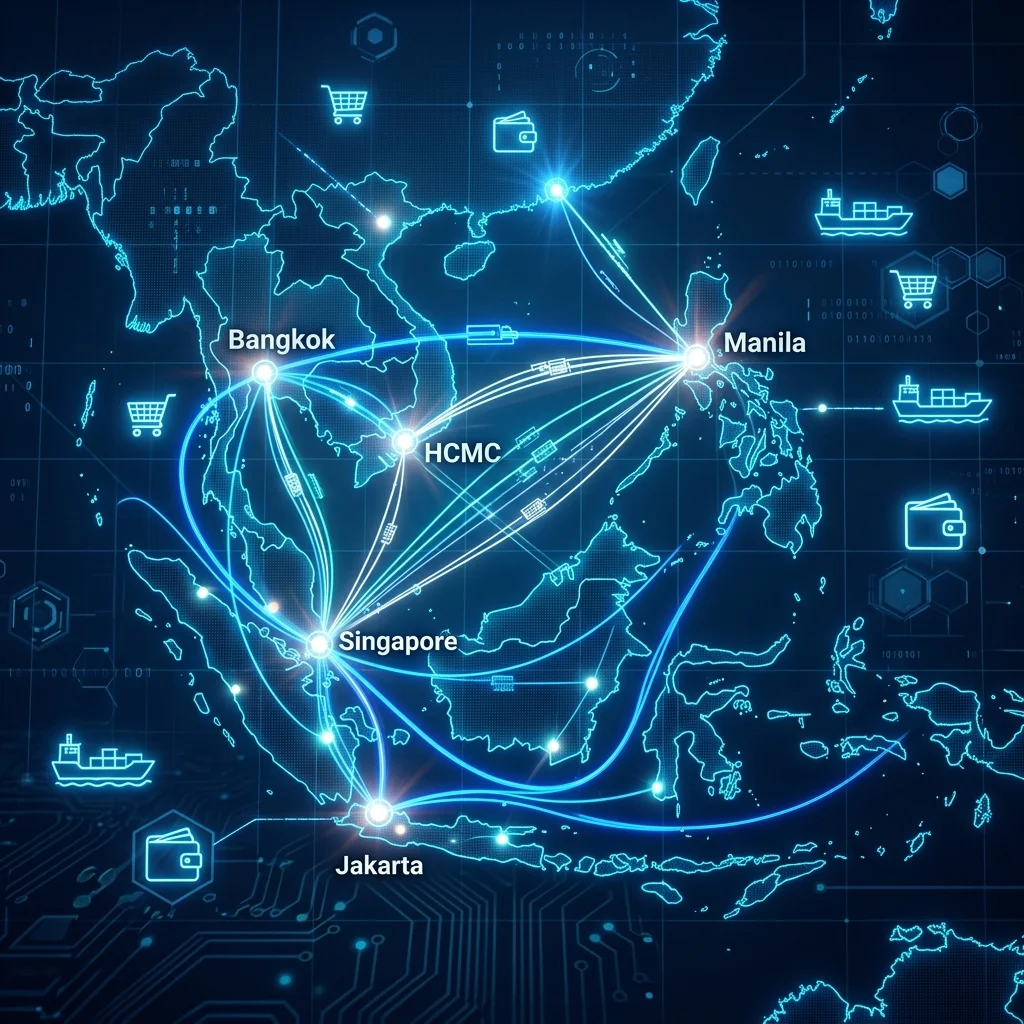
[IMAGE: Map of Southeast Asia with icons representing logistics hubs (ports, airports, warehouses) and digital payment flows (arrows between countries). Highlight Singapore as a transshipment hub, Bangkok as a regional warehouse center, and Jakarta as a high-density last-mile challenge area.]
Countries with lower cross-border indexes face higher friction costs. For Indonesia, where the index score of 54.3 reflects fragmented warehousing and customs delays, the cost of cross-border logistics can be 1.5 to 2 times higher than in Singapore. These inefficiencies discourage smaller merchants from selling internationally and increase final prices for consumers.
To address this, governments and private players are investing heavily:
- Logistics automation: Thailand’s Eastern Economic Corridor (EEC) is attracting major warehouse and fulfillment center investments, with automated sorting systems that can process over 100,000 parcels per day.
- Customs digitization: Indonesia’s National Single Window (NSW) initiative is gradually integrating customs, port, and trade documentation systems, though full implementation remains years away.
- Digital payment rails: The ASEAN Payment Connectivity initiative, launched in 2022, aims to link real-time payment systems across member states, allowing cross-border QR payments between Thailand, Indonesia, Malaysia, Singapore, and the Philippines.
- Last-mile innovation: In the Philippines, where geography presents unique challenges (over 7,000 islands), companies like Ninja Van and Lalamove are deploying AI-driven route optimization and partner networks of sari-sari stores (small neighborhood shops) as pickup points.
The implications for supply chains are profound. As ecommerce penetration deepens, traditional retail distribution models are being disrupted. Brands that previously relied on wholesalers and physical storefronts are now building direct-to-consumer (D2C) channels, requiring localized warehousing and flexible fulfillment. Meanwhile, the rise of social commerce—particularly TikTok Shop’s rapid growth in Vietnam and Thailand—demands inventory strategies that can handle viral demand spikes without overstocking.
---
Outlook: Which Markets Will Capitalize by 2030?
The divergence in infrastructure readiness means that not all Southeast Asian markets will enjoy the same ecommerce growth trajectory. Based on current trends, three factors will separate the leaders from the laggards:
- Logistics density and last-mile efficiency – Markets like Thailand and Malaysia, with relatively strong road networks, port infrastructure, and warehousing capacity, are best positioned to scale cross-border and domestic ecommerce.
- Payment system integration – Singapore leads here, but Thailand and Indonesia are catching up quickly through QR code interoperability and open banking frameworks.
- Regulatory alignment – Customs digitization, data localization rules, and tax harmonization will determine how easily cross-border trade flows. The ASEAN digital economy framework agreement, currently under negotiation, could be a game-changer if ratified by 2025.
Vietnam, despite its lower cross-border index score, is a wildcard. Its young population (median age 31), rapid smartphone adoption (over 70% penetration), and government push for digital transformation could propel it past more “infrastructure-ready” neighbors. The Philippines, similarly, has massive demographic potential but is held back by logistical fragmentation.
[IMAGE: Projected ecommerce market size bar chart for 2030 across SEA countries, with growth rate annotations. Show Vietnam and Philippines as high-growth but lower-base, Indonesia as dominant, Thailand and Malaysia as steady, Singapore as mature.]
By 2030, Southeast Asia’s ecommerce market could exceed USD $300 billion in gross merchandise value, up from roughly USD $150 billion in 2023. That growth, however, will be unevenly distributed. The hidden infrastructure race—spanning logistics, payments, and regulatory reform—will determine which markets not only ride the wave but shape its direction.
For investors, policymakers, and business leaders, the message is clear: the next frontier of Southeast Asian ecommerce is not about catching consumer demand—it’s about building the invisible systems that make that demand deliverable. The race has already begun.