South Asia''s Infrastructure Paradox: Why Billions in Corridor Investments
South Asia invests heavily in logistics corridors—INSTC, SASEC, CPEC, BBIN,
South Asia’s Infrastructure Paradox: Why Billions in Corridor Investments Haven’t Boosted Regional Trade
A $3 trillion trade opportunity remains trapped behind border bottlenecks, customs delays, and fragmented regulations—while hardware projects race ahead.
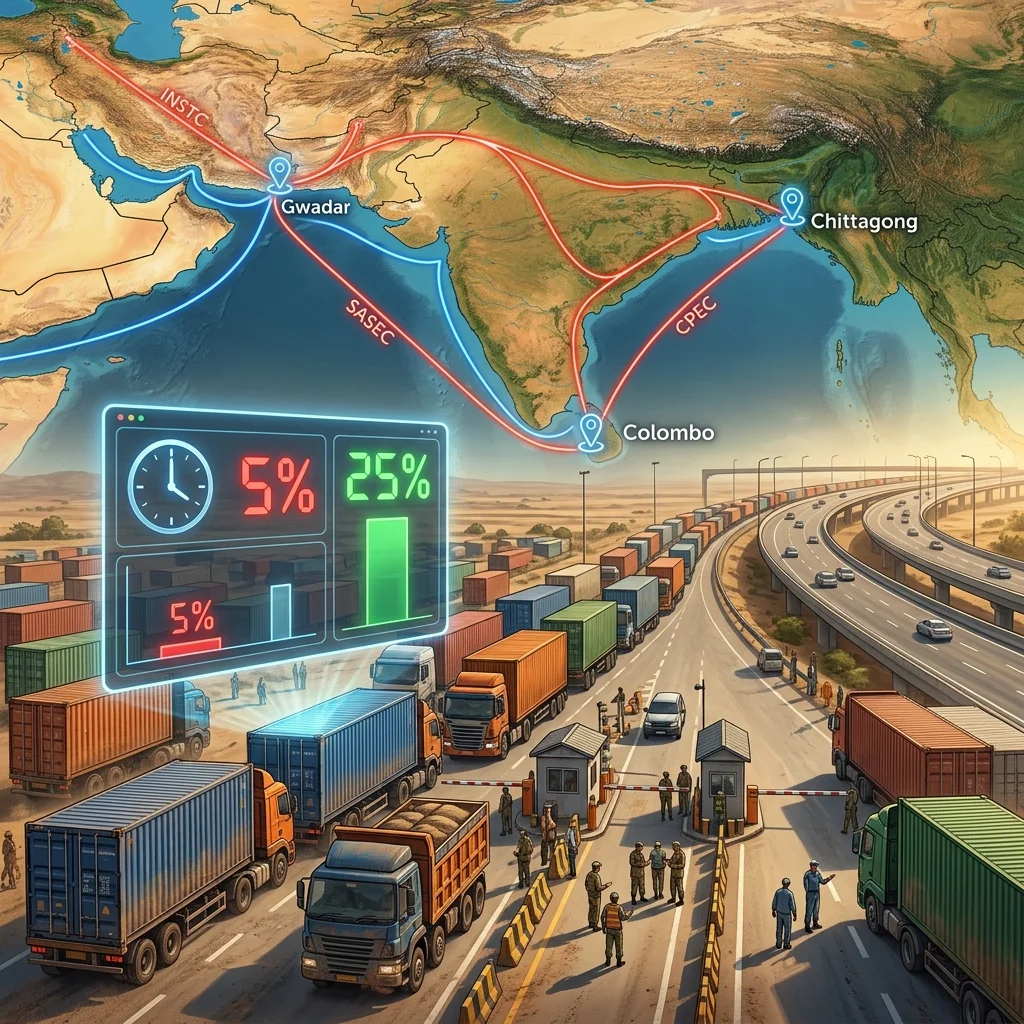
[IMAGE: Infographic comparing South Asia’s 5% intra-regional trade vs ASEAN’s 25%, with icons of trucks and ships.]
---
Introduction: The $3 Trillion Opportunity Stuck at the Border
South Asia is one of the world’s fastest-growing economic regions, home to nearly 2 billion people and a combined GDP approaching $4.5 trillion. Yet for all its promise, the region trades with itself at a fraction of its potential. Intra-regional trade stands at a mere 5% of total trade—a figure one-fifth of ASEAN’s 25%, and dwarfed by the European Union’s 60%. The gap represents an estimated $3 trillion in unrealized economic opportunity.
The paradox is sharp: South Asian governments have poured tens of billions of dollars into logistics corridors—the International North-South Transport Corridor (INSTC), the South Asia Subregional Economic Cooperation (SASEC) program, the China-Pakistan Economic Corridor (CPEC), the Bangladesh-Bhutan-India-Nepal (BBIN) Motor Vehicles Agreement, and national mega-projects like India’s Bharatmala highway network. Roads are being paved, ports expanded, and railways electrified. Yet trade volumes remain stubbornly flat.
The core thesis of this article is that physical infrastructure—what experts call “hardware”—is being built at an impressive pace, but the “software” of trade integration—customs harmonization, regulatory interoperability, digital platforms, and consistent bilateral agreements—remains broken. Without simultaneous institutional reform, even the most ambitious corridors remain hollow.
This deep dive examines the cost-saving potential of INSTC, the systemic delays at South Asia’s busiest border crossing at Petrapole-Benapole, and the promise of digital platforms like ULIP and multilateral agreements like BBIN. The findings reveal a region caught between world-class aspirations and ground-level friction.
---
The Current State: A Tale of Two Worlds
The 5% vs. 25% Gap
World Bank data confirms a stark reality: South Asia’s intra-regional trade intensity is the lowest of any major world region. In contrast, ASEAN—with comparable population density, geographic proximity, and a mix of developing and emerging economies—achieves 25%. The difference cannot be explained by economic structure alone. Tariffs in South Asia have fallen significantly over the past two decades. Non-tariff barriers, however, have proliferated.
[IMAGE: Photo of long truck queue at Petrapole-Benapole land port, with a small inset map showing the border location.]
Petrapole-Benapole: A Microcosm of Systemic Friction
Nowhere is the friction more visible than at the Petrapole-Benapole land border crossing between India and Bangladesh. This is South Asia’s busiest bilateral trade point, handling roughly 60% of all India-Bangladesh trade. Yet trucks routinely wait 24 to 72 hours to cross. The causes are not a lack of road space—both sides have upgraded highways leading to the border. Rather, the delays stem from multiple customs inspections, inconsistent documentation requirements, incompatible weighing systems, and a lack of digital coordination. A recent study by the Bangladesh Trade Facilitation Working Group found that each hour of delay costs traders an average of $40 per truck in demurrage, spoilage, and lost time.
These bottlenecks are not unique. Similar choke points exist at the India-Nepal border at Raxaul-Birgunj, the India-Pakistan border at Wagah, and the Myanmar-India border at Moreh-Tamu. The cumulative cost of these delays has been estimated at billions of dollars annually.
The INSTC Success Story That Almost Was
The potential of addressing these barriers is vividly illustrated by the International North-South Transport Corridor (INSTC). In 2014, a test shipment of 15 tons of tea from India to Russia via the INSTC route—linking India, Iran, and Russia through the Caspian Sea—achieved a transit time of 14 days, compared to the traditional 40-day sea route through the Suez Canal. The cost saving was approximately $2,500 per 15 tons, or about $166 per ton. Follow-up pilot shipments in 2022 confirmed similar savings for containerized cargo.
Yet despite these results, INSTC remains underutilized. Volumes have not scaled as expected. The reasons include geopolitical tensions (U.S. sanctions on Iran, instability in the Caucasus), lack of private-sector confidence, and insufficient digital tracking systems. The hardware—rail lines, ports, and roads—is largely in place. The software—insurance frameworks, customs coordination, and bank payment mechanisms—is not.
---
The Landscape of Corridor Investments
INSTC: Multi-modal Promise, Geopolitical Risk
The INSTC is a 7,200-kilometer multi-modal network linking St. Petersburg and Moscow to the Persian Gulf and Indian Ocean via Iran and Azerbaijan. When fully operational, it could reduce freight costs between India and Russia by 30% and cut transit time by 40%. The route has received investment commitments from Russia, Iran, India, and Azerbaijan totaling several billion dollars. However, the corridor faces headwinds: sanctions on Iran, the war in Ukraine, and the reluctance of shipping lines to commit to long-term schedules. The corridor’s full potential will remain locked until institutional frameworks catch up with the physical network.
SASEC Program: Six Corridors, Uneven Progress
The South Asia Subregional Economic Cooperation (SASEC) program, funded primarily by the Asian Development Bank (ADB), has identified six major economic corridors connecting India, Bangladesh, Bhutan, Nepal, and Sri Lanka. These corridors—such as the Kolkata-Dhaka-Agartala corridor and the East-West Corridor linking Nepal with Bangladesh—are designed to reduce transport costs, improve logistics, and spur cross-border trade. SASEC has invested over $4 billion in road upgrades, border facilities, and customs modernization projects since 2001.
However, progress remains uneven. While India’s Bharatmala Pariyojana (a national highway development project) has built thousands of kilometers of high-speed roads, connecting to SASEC corridors often stalls at the border. The Indian side of the Petrapole crossing has seen major upgrades; the Bangladesh side still lacks a dedicated customs warehouse and electronic data interchange. The hardware-software disconnect is stark.
CPEC: China’s Strategic Investment with Limited Regional Integration
The China-Pakistan Economic Corridor (CPEC) is the most heavily funded infrastructure project in South Asia, with over $25 billion in Chinese investment in Pakistan’s Gwadar Port, road networks, and energy projects. CPEC’s intended scope extends beyond Pakistan: Chinese planners envision it as a gateway for trade with Afghanistan, Central Asia, and even India. Yet CPEC’s integration with South Asian neighbors is minimal. India’s political objections to CPEC’s route through Pakistan-administered Kashmir have prevented any cross-border logistics cooperation. Even within Pakistan, operational inefficiencies at Gwadar—including low container throughput and limited connectivity to inland markets—underscore that hardware alone does not create trade.
BBIN Motor Vehicles Agreement: A Paper Victory
The Bangladesh-Bhutan-India-Nepal (BBIN) Motor Vehicles Agreement, signed in 2015, was hailed as a breakthrough for seamless cargo movement across four countries. The agreement allows trucks to cross borders without transshipment, reducing time and costs. Pilots have been conducted on routes like Kolkata to Dhaka and Kathmandu. Yet full implementation remains elusive. Bhutan has not ratified the agreement due to domestic environmental concerns. Nepal and India have bilateral disputes over trucking permits. Standardized customs procedures are still under negotiation. The result: BBIN exists largely on paper, with most cargo still unloaded and reloaded at borders.
National Initiatives: Bharatmala, Sagarmala, and the Digital Leap
India’s Bharatmala Pariyojana, a $100 billion highway development program, is the country’s most ambitious road-building effort. It aims to connect 550 districts through 34,800 kilometers of national highways, including economic corridors that feed into SASEC and INSTC routes. Similarly, the Sagarmala project focuses on port modernization and connectivity to inland logistics hubs. The Dedicated Freight Corridors (Eastern and Western) are transforming rail freight between Delhi and Mumbai, but their eastward extension toward Bangladesh and Nepal is still in planning stages.
On the digital front, India’s Unified Logistics Interface Platform (ULIP) is a game changer. ULIP integrates data from 27 government systems—including customs, port, railway, and road transport—into a single API for logistics providers. It enables real-time tracking, electronic documentation, and automated clearances. Launched in 2022, ULIP is already streamlining logistics within India. Its potential for cross-border use, however, requires collaboration with neighboring countries. If extended to Bangladesh or Nepal, ULIP could cut border delays by 30–40%.
Bangladesh and Sri Lanka: Port Expansions Under Pressure
Bangladesh’s Chittagong Port handles over 90% of the country’s international trade, but chronic congestion—vessels wait an average of 5–7 days to berth—has prompted investments in dry ports and special economic zones. The Matarbari deep-sea port, under construction with Japanese assistance, aims to relieve pressure, but its completion is years away. Meanwhile, Sri Lanka’s Colombo Port, a key transshipment hub for South Asia, is undergoing public-private expansion. The ADB-funded Eastern Corridor Development project in India, Nepal, and Bangladesh seeks to link these port expansions with road and rail upgrades inland. The ambition is clear; the execution lags.
[IMAGE: Stylized map of South Asia with glowing red and blue lines representing major trade corridors (INSTC, SASEC, CPEC) converging on key ports like Gwadar, Chittagong, and Colombo. Foreground shows container trucks stopped at a border crossing with a long queue; digital overlay shows trade statistics (5% vs 25%) and a clock symbolizing delays.]
---
Barriers That Persist: The Hidden Cost of Fragmentation
Customs Delays and Regulatory Fragmentation
Even where physical infrastructure has improved, customs procedures remain a major obstacle. South Asian countries employ different tariff classification systems, inconsistent valuation methods, and varying phytosanitary and product standards. A truck carrying textiles from India to Bangladesh may be inspected three times—once at the factory, once at the border by Indian customs, and once again by Bangladeshi customs. Harmonizing these procedures under a common regional framework—such as the WTO Trade Facilitation Agreement—remains a political challenge.
Inconsistent Bilateral Agreements
Bilateral trade agreements in South Asia are often lopsided or inconsistently enforced. India has sensitive lists with Nepal and Bangladesh that exclude thousands of products from preferential tariffs. The South Asian Free Trade Area (SAFTA) has failed to deliver meaningful liberalization due to India-Pakistan tensions. Without a stable, predictable legal framework for cross-border trade, investors and logistics providers hesitate to commit to corridor-based supply chains.
Digital Interoperability: The Missing Link
Digital platforms like ULIP exist in isolation. India’s customs system does not talk directly to Bangladesh’s. A consignment that clears Indian customs electronically may still require paper documents when crossing into Nepal. The lack of a region-wide digital single window means that traders duplicate documentation, pay for manual verification, and suffer delays. Pilot projects for electronic data interchange (EDI) at Petrapole-Benapole have been running for years but are not yet fully operational.
---
The Path Forward: Unlocking the $3 Trillion Opportunity
Recommendation 1: Prioritize Software Over Hardware
Governments and development banks must rebalance investment portfolios. For every dollar spent on concrete and steel, a significant portion should be allocated to customs modernization, digital interoperability, and regional regulatory harmonization. The SASEC program’s next phase should focus on operationalizing existing corridors rather than building new ones.
Recommendation 2: Institutionalize Digital Integration
Scaling platforms like ULIP across borders—with data localization safeguards and shared standards—could dramatically reduce clearance times. A regional digital logistics platform, built on existing frameworks, would allow traders to submit documents once, track shipments across countries, and receive automatic clearances. The ADB and World Bank could provide technical assistance and funding for this initiative.
Recommendation 3: Revive and Expand BBIN
The BBIN Motor Vehicles Agreement should be relaunched with a realistic timeline, involving Bhutan’s ratification and Nepal’s implementation. A pilot “green lane” for certified traders—already proven in ASEAN’s Green Lane initiative—could demonstrate the benefits of seamless transit without requiring full harmonization from day one.
Recommendation 4: De-risk Corridors for Private Capital
Geopolitical uncertainty discourages private investment in corridors like INSTC and CPEC. Governments could offer political risk insurance, multilateral guarantees, and long-term concession agreements to attract private logistics operators. Corridor development funds, structured like infrastructure bonds, could crowd in institutional capital.
Recommendation 5: Measure and Publish Border Performance
Transparency is a powerful lever. The World Bank’s Logistics Performance Index should be supplemented with real-time border crossing time data, published monthly for key crossings like Petrapole-Benapole, Raxaul-Birgunj, and Wagah. Publicizing these metrics would create pressure for reform and allow traders to optimize routes.
---
Conclusion: From Hollow Corridors to Living Highways
South Asia’s infrastructure paradox is not an argument against investment. It is a call for a more intelligent approach. The billions spent on Bharatmala, SASEC, INSTC, and CPEC have created impressive hardware. But the software of trade—customs cooperation, digital integration, and consistent bilateral rules—remains a decade behind.
The region’s $3 trillion trade potential will not be unlocked by building more roads alone. It requires leaders to acknowledge that a corridor is only as strong as its weakest link. Until customs clearance at Petrapole-Benapole takes minutes instead of hours, until ULIP talks to Bangladesh’s National Single Window, and until BBIN trucks roll seamlessly from Kolkata to Kathmandu, these multibillion-dollar corridors will remain hollow.
The solution is neither simple nor cheap. It demands political will, institutional reform, and sustained regional dialogue. But the prize—a South Asia that trades with itself as efficiently as it trades with the world—is worth the journey. The paradox can be resolved. The question is whether the region’s governments are ready to look beyond the concrete and confront the software challenge head-on.