Asia''s Logistics Infrastructure Transformation: Port Automation, Warehouse
Asia’s logistics infrastructure is undergoing a radical overhaul as ports
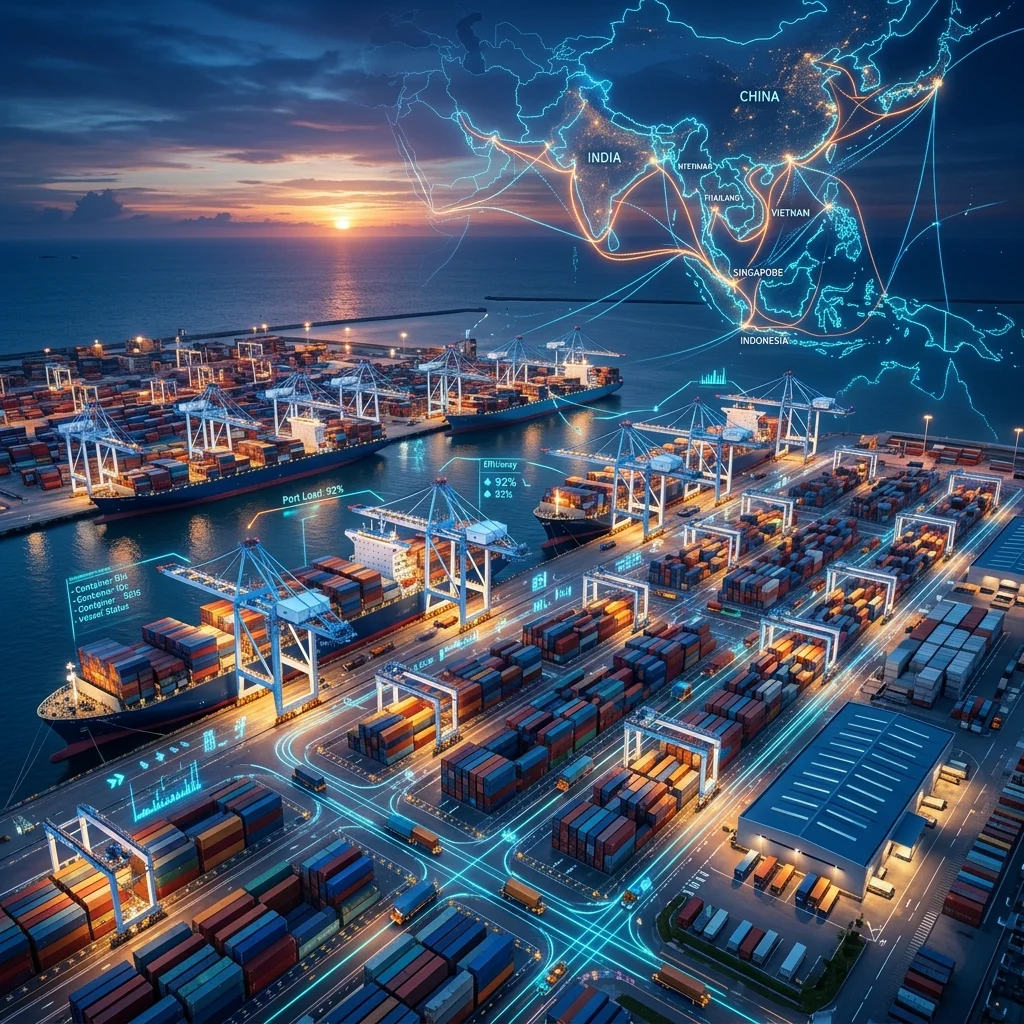
Asia’s Logistics Infrastructure Transformation: Port Automation, Warehouse Tech, and Trade Corridors Reshaping 2025
Introduction: Ports as Active Competitors in Global Trade
For decades, ports were passive intermediaries—geographic endpoints where cargo moved from ship to shore with little strategic differentiation. That era is ending. Across Asia, ports are reinventing themselves as active competitors for trade flows, investing heavily in automation, digitalization, and expansion to capture the billions of dollars in shifting global supply chains. This transformation is driven by three forces: the explosive growth of e-commerce logistics, the relocation of manufacturing from China to Southeast and South Asia, and the implementation of trade agreements like RCEP and CPTPP that lower barriers and increase cross-border traffic.
The scale of ambition is unmistakable. Colombo port in Sri Lanka, a key hub in South Asia, projects its container throughput to reach 6.2 million TEUs by 2025 and 9 million by 2030—nearly doubling its current capacity. Such targets are not isolated. From Indonesia’s new deep-sea ports to Vietnam’s expanding terminals, the race for supply chain dominance is intensifying. Ports are no longer just infrastructure; they are strategic assets that shape the cost, speed, and resilience of global trade.
[IMAGE: An infographic showing key port throughput figures across Asia (Shanghai, Colombo, Singapore, etc.) with growth arrows.]
Mega-Port Expansions and Automation in Southeast Asia
Southeast Asia is at the epicenter of port infrastructure investment. Indonesia is developing the Patimban deep-sea port near Jakarta to relieve congestion at Tanjung Priok and serve a booming automotive export industry. Vietnam is expanding Cai Mep-Thi Vai port complex to accommodate larger vessels, while Malaysia’s Port Klang and Tanjung Pelepas compete for transshipment traffic diverted from Singapore. These projects require billions of dollars in capital, often backed by public-private partnerships and foreign investment.
Automation is the defining technological trend. China’s Yangshan Deep-Water Port in Shanghai operates with automated guided vehicles and remote-controlled cranes, achieving turnaround times of under 24 hours for mega-ships. Shenzhen’s Yantian port has deployed AI-driven yard management systems that optimize container stacking and reduce idle time. These benchmarks set a new standard: ports that fail to automate risk being bypassed by shipping lines seeking efficiency.
However, automation creates a technology divide. Advanced ports in China, Singapore, and South Korea can invest in full automation, while emerging ports in Myanmar, Cambodia, and Bangladesh struggle with basic infrastructure. The gap is partly bridged by modular automation—retrofitting existing terminals with semi-automated cranes and digital gate systems that deliver incremental gains without the full capital cost. Yet the pressure is mounting: as e-commerce logistics demands faster turnaround and tighter schedules, even second-tier ports must upgrade or lose market share.
[IMAGE: Photo of Shanghai Yangshan Deep-Water Port with automated gantry cranes and container stacks.]
Warehouse Automation and Land-Scarcity Innovations
The surge in e-commerce across Southeast Asia is driving double-digit growth in warehouse automation. According to industry estimates, the region’s warehouse automation market is expanding at 12–15% annually, fueled by fulfillment demands from platforms like Shopee, Lazada, and TikTok Shop. Companies are deploying automated storage and retrieval systems (AS/RS), autonomous mobile robots, and AI-powered sorting lines to handle the increasing volume of small-parcel orders.
Land scarcity in major cities is pushing innovation. In Manila, where industrial land prices have more than doubled in five years, developers are experimenting with vertical warehouses—multi-story facilities with automated lifts and conveyor systems that maximize storage density. Some projects even combine retail on ground floors with logistics fulfillment on upper levels, a hybrid model known as “retail-logistics.” These vertical warehouses reduce the footprint needed for last-mile operations while keeping goods close to urban consumers.
Vietnam offers a parallel story. Industrial parks near Hanoi and Ho Chi Minh City report over 80% occupancy, with strong demand from electronics, textile, and automotive manufacturers. This tight supply is pushing up rents and forcing logistics operators to adopt automation to improve space utilization. Automated pallet shuttles and high-bay racking systems are becoming standard in new builds, while existing warehouses are retrofitted with IoT sensors for real-time inventory tracking.
[IMAGE: Vertical warehouse in Manila with automated storage and retrieval systems, rooftop parking for delivery vans.]
Digital Customs and Blockchain Collaboration
While physical infrastructure expands, digital customs systems are quietly revolutionizing cross-border trade. Singapore and Malaysia’s customs authorities have collaborated with logistics players such as CF Global and GAC on blockchain-based documentation platforms. These systems replace paper bills of lading, certificates of origin, and invoices with tamper-proof digital records shared across the supply chain. The result: clearance times cut from days to hours, reduced paperwork errors, and enhanced transparency for regulators.
Blockchain customs is particularly critical for RCEP supply chain integration. The agreement, which entered force in 2022, requires harmonized customs procedures among 15 Asia-Pacific nations. Blockchain provides a trusted protocol for sharing data without centralizing control—enabling seamless “single-window” clearance for shipments moving from, say, a factory in Vietnam to a distribution center in South Korea. The Cooperative Logistics Network, a global alliance of independent freight forwarders, has adopted blockchain to verify the authenticity of documents for its members in Asia. Equalbase, a Singapore-based logistics real estate firm, uses blockchain to track warehouse occupancy and carbon offsets, creating transparency for tenants and investors.
Yet adoption is uneven. Smaller ports and customs agencies lack the technical infrastructure and legal frameworks to implement blockchain fully. Pilot projects in India and Thailand show promise, but scaling requires government commitment to interoperability standards. The payoff is substantial: every one-hour reduction in customs clearance can reduce total logistics costs by 1–2% for time-sensitive goods like electronics and perishables.
[IMAGE: A diagram showing a blockchain ledger linking a container shipment from port to warehouse with customs clearance milestones timestamped.]
Inland Transport Bottlenecks: The Persistent Weak Link
The most advanced ports and warehouses cannot compensate for broken inland transport. Across Asia, roads and railways are the critical bottleneck. In India, the ambitious Dedicated Freight Corridor (DFC) projects aim to connect Delhi, Mumbai, Chennai, and Kolkata with high-capacity rail lines, but delays and cost overruns have pushed completion well past 2025. Meanwhile, trucks moving goods from Chennai port to Bangalore face 12–18 hours of delays due to congested highways and multiple toll plazas—erasing the time saved by port automation.
Southeast Asia fares no better. In Vietnam, the highway network is expanding rapidly, but connections between industrial parks in Binh Duong province and Cai Mep port are still clogged during peak seasons. Indonesia’s Trans-Java toll road has improved connectivity, but the lack of rail freight alternatives means that 90% of cargo still moves by truck. The mismatch between port capacity and inland infrastructure creates a “last-mile gap” that undermines the entire logistics chain.
South Asia infrastructure investment projects are attempting to address this. The Asian Development Bank has financed road upgrades in Bangladesh and Nepal, while Japan’s JICA supports urban logistics hubs in Ho Chi Minh City. These are piecemeal solutions. What’s needed is integrated corridor planning: aligning port expansion with rail electrification, warehouse zoning, and customs digitalization. Without it, the billions spent on terminals risk being wasted.
Policy Frameworks: RCEP and Make in India as Catalysts
Trade and industrial policies are accelerating the transformation. RCEP’s rules of origin allow goods to be manufactured with components from multiple member countries and still qualify for tariff preferences—encouraging regional supply chains. This has spurred investment in integrated logistics hubs near borders, such as the Thailand–Laos railway link and the new dry port in Bac Ninh, Vietnam, which serves electronics manufacturers assembling parts from China and Japan.
India’s Make in India initiative, combined with production-linked incentive (PLI) schemes for electronics, automotive, and pharmaceuticals, has attracted global manufacturers to set up factories in Tamil Nadu, Gujarat, and Andhra Pradesh. These factories require modern logistics infrastructure, from temperature-controlled warehousing to connected rail freight. The government has responded by designating 100 logistics parks under the National Logistics Policy, but implementation is slow.
The interplay between policy and infrastructure is complex. RCEP’s push for harmonization contrasts with India’s cautious approach to trade liberalization. Yet both recognize that logistics is a competitive advantage. Countries that build seamless corridors—port → warehouse → highway → factory—will attract the next wave of manufacturing investment.
Long-Term Implications for Supply Chain Resilience and Cost Structures
The transformation of Asia’s logistics infrastructure carries profound implications. First, supply chain resilience improves. Automated ports reduce dependency on manual labor, which can be disrupted by pandemics or labor strikes. Blockchain customs creates redundant digital records that survive physical damage. Diversified trade corridors (e.g., bypassing the Malacca Strait via Indonesia’s new ports) mitigate geopolitical risks.
Second, cost structures are shifting. Automation reduces variable labor costs but increases fixed capital costs. For shippers, this means lower per-unit handling fees at automated ports but higher storage fees at vertically integrated warehouses. The net effect is a bifurcation: high-volume, low-value commodities will gravitate toward highly automated mega-ports, while high-value, time-sensitive goods will pay a premium for integrated digital customs and multimodal connectivity.
Third, e-commerce logistics growth will continue to shape demand. Last-mile delivery networks are expanding into secondary cities, creating pressure for mid-size warehouse hubs near tier-2 and tier-3 cities. Companies like Shopee are building their own sortation centers with automated sorting machines, bypassing traditional warehousing for faster fulfillment.
Finally, the technology divide risks creating a two-tier Asia. Ports and logistics hubs in developed economies (Singapore, South Korea, Japan, China’s coastal regions) will achieve near-full automation, while emerging economies (Bangladesh, Myanmar, Cambodia) struggle with basic road infrastructure and manual customs. Closing this gap requires coordinated investment from multilateral development banks, technology transfer, and policy reforms that prioritize logistics as a national priority.
Conclusion: The Race for Dominance Is Just Beginning
Asia’s logistics infrastructure is being rebuilt from the ground up, driven by e-commerce, manufacturing shifts, and geopolitical realignments. Ports are becoming active competitors; warehouses are going vertical; customs are going digital; and corridors are being reimagined. The targets are ambitious: Colombo reaching 6.2 million TEUs, Vietnam’s industrial parks at over 80% occupancy, and blockchain connecting ports from Singapore to Manila.
Yet the journey is far from complete. Inland transport remains the weakest link, and the technology divide threatens to leave smaller economies behind. The winners in this race will be those that integrate physical infrastructure with digital systems—seamlessly connecting automated cranes, blockchain customs, and smart highways. For businesses operating in Asia, the message is clear: logistics is no longer a back-office cost. It is a strategic differentiator that will define competitiveness in 2025 and beyond.