South Asia''s Integration Puzzle: Lessons from ASEAN on Bridging the Divide
Despite centuries-old trade ties, South and Southeast Asia remain far less
South Asia's Integration Puzzle: Lessons from ASEAN on Bridging the Divide
Introduction: The Paradox of Proximity
For centuries, the Bay of Bengal served as a highway of commerce, linking the ports of Chennai, Chittagong, and Colombo with the bustling markets of Penang, Jakarta, and Bangkok. Spices, textiles, and ideas flowed freely across these waters, creating economic and cultural ties that predate modern nation-states. Yet today, despite this shared history and geographic adjacency, trade between South Asia and Southeast Asia remains stubbornly low.
The numbers tell a troubling story. Intra-regional trade within South Asia hovers around 5 percent of total trade—among the lowest of any region in the world. Trade between South Asia and Southeast Asia, while somewhat higher, still falls far short of its potential. As economist Jayant Menon puts it: "Despite their proximity and commercial ties that date back centuries, trade and investment between Southeast Asia and South Asia remain way below their potential."
[IMAGE: A historical trade route map of the Bay of Bengal region]
This is the paradox of proximity: two neighboring regions, rich in resources, labor, and market size, yet unable to translate physical closeness into economic integration. Meanwhile, Southeast Asia—through ASEAN—has built one of the developing world's most successful regional integration models. Why has South Asia failed to replicate this success? The answer lies in a complex interplay of late policy shifts, institutional weakness, and a failure to plug into global value chains.
---
The Hard Numbers: Trade and Investment in Single Digits
Let us begin with the data, because the gap is stark. The share of exports and imports between South and Southeast Asia remains below 15 percent—often stuck in single digits for individual countries. Bangladesh exports less to Myanmar, its immediate neighbor, than it does to markets in Europe. India's trade with ASEAN, while growing, still represents only a fraction of its global trade volume.
Contrast this with intra-ASEAN trade, which consistently exceeds 20 percent of the bloc's total trade. East Asia's participation in global value chains (GVCs) is among the highest in the world, with countries like Malaysia, Vietnam, and Thailand deeply embedded in electronics, automotive, and textile supply chains. South Asia, by comparison, remains largely disconnected from these production networks.
[IMAGE: Bar chart comparing intra-regional trade shares of ASEAN, SAARC, and BIMSTEC]
The exclusion of India from the Regional Comprehensive Economic Partnership (RCEP), signed in 2020, serves as a symbolic and practical reminder of this gap. RCEP, which brings together ASEAN plus China, Japan, South Korea, Australia, and New Zealand, represents the world's largest free trade agreement. India's decision to stay out—driven by fears of import surges and inadequate domestic competitiveness—highlighted the defensive posture that has long characterized South Asian trade policy.
The result is a region that trades more with the rest of the world than with its own neighbors. South Asian countries export similar products—textiles, agricultural goods, low-end manufactures—making them competitors rather than complementarities. Without deeper integration, the potential for intra-regional specialization and scale economies remains untapped.
---
Historical Divergence: Timing of Policy Shifts
Why did South Asia fall behind? A critical factor is timing. Southeast Asian economies began their shift from import substitution to export-oriented industrialization in the 1960s and 1970s. Singapore, Malaysia, and Thailand adopted outward-looking policies early, attracting foreign direct investment (FDI) and integrating into global supply chains.
ASEAN itself was founded in 1967, but the real transformation came with the ASEAN Free Trade Area (AFTA) in 1992. AFTA was built on the principle of "open regionalism"—liberalizing trade not just within the bloc but also with external partners. This approach attracted multinational corporations seeking efficient production bases, and it created a virtuous cycle: trade liberalization attracted FDI, which boosted exports, which financed further infrastructure investment.
[IMAGE: Timeline showing policy milestones: ASEAN (1967), AFTA (1992), SAARC (1987), BIMSTEC (1997)]
South Asia's trajectory was different. Countries like India, Pakistan, and Bangladesh maintained protectionist, import-substitution regimes well into the 1980s and even 1990s. India's landmark economic reforms came only in 1991, a full two decades after Southeast Asia's liberalization. By then, the region had already locked in high trade costs, weak infrastructure, and protectionist habits that proved difficult to reverse.
The South Asian Association for Regional Cooperation (SAARC), formed in 1987, was hampered from the start by political tensions—particularly between India and Pakistan. Its South Asian Free Trade Area (SAFTA), signed in 2004, never achieved meaningful tariff reductions due to the inclusion of lengthy negative lists and sensitive product exclusions. Late liberalization created a path dependency: industries accustomed to protection resisted opening, and governments feared the political fallout of import competition.
---
Institutional Comparison: SAARC, BIMSTEC, and the ASEAN Model
Institutional design also matters. ASEAN's success rests on several pillars: consensus-based decision-making, a focus on tangible economic outcomes, and a willingness to engage with external partners. The bloc's "ASEAN Way" of informal, non-confrontational diplomacy has allowed it to navigate political differences while pushing forward economic integration.
Crucially, ASEAN complemented its regional framework with subregional programs that delivered concrete results. The Greater Mekong Subregion (GMS) program, launched in 1992 with support from the Asian Development Bank (ADB), built cross-border highways, bridges, and energy links connecting Thailand, Vietnam, Laos, Cambodia, Myanmar, and China's Yunnan Province. Similar subregional initiatives—the Brunei-Indonesia-Malaysia-Philippines East ASEAN Growth Area (BIMP-EAGA) and the Indonesia-Malaysia-Thailand Growth Triangle (IMT-GT)—focused on infrastructure and connectivity in border areas.
[IMAGE: Venn diagram of overlapping memberships: SAARC, BIMSTEC, SASEC, ASEAN]
South Asia's institutions have not enjoyed the same success. SAARC is widely regarded as paralyzed by the India-Pakistan rivalry, with few meaningful outcomes since its founding. BIMSTEC (Bay of Bengal Initiative for Multi-Sectoral Technical and Economic Cooperation), formed in 1997, offers a more pragmatic alternative. It brings together countries from both South Asia (India, Bangladesh, Sri Lanka, Nepal, Bhutan, Maldives) and Southeast Asia (Myanmar, Thailand), sidestepping the India-Pakistan deadlock.
BIMSTEC has progressed slowly but deliberately. It has identified 14 priority sectors, from trade and investment to energy and transport, and is currently negotiating a BIMSTEC Free Trade Area (FTA). However, the FTA has been under discussion for nearly two decades, reflecting the cautious approach of member states. The ASEAN experience suggests that maximizing the benefits of an FTA requires openness to both internal and external partners—a lesson BIMSTEC must take to heart.
---
The Missing Link: Global Value Chains and Trade Costs
Perhaps the most critical missing element is participation in global value chains (GVCs). Most Southeast Asian countries are deeply integrated into GVCs: they import components, add value through assembly or processing, and export finished goods. This model has driven industrialization, job creation, and technology transfer across the region.
South Asia, by contrast, remains largely outside these networks. The reasons are not mysterious. High trade costs—including tariffs, non-tariff barriers, poor logistics, and inefficient customs procedures—discourage the kind of just-in-time production that GVCs require. An ADB study found that trade costs in South Asia are among the highest in the world, equivalent to a tariff of over 200 percent in some cases.
[IMAGE: Infographic showing supply chain nodes in Southeast Asia versus missing links in South Asia]
Consider the contrast with the GMS program. By reducing cross-border delays and improving transport corridors, GMS countries cut the time required to move goods between major cities by 40 to 50 percent. In South Asia, a truck carrying goods from Delhi to Dhaka can still face multiple days of delays at border crossings due to cumbersome documentation and lack of coordinated customs systems.
High trade costs have a direct impact on GVC participation. When it is costly and unpredictable to import components, firms cannot compete in fast-moving global supply chains. They remain stuck in low-value, domestically oriented production. Breaking this cycle requires not just tariff reductions but comprehensive trade facilitation: single-window customs systems, harmonized standards, improved road and port infrastructure, and better regional connectivity.
---
Lessons from ASEAN for BIMSTEC's FTA and Beyond
What can South Asia learn from ASEAN? The most important lesson is the value of open regionalism. ASEAN did not build its integration model as a fortress; it liberalized trade with both members and non-members, recognizing that global integration is a complement to, not a substitute for, regional integration. BIMSTEC's FTA must avoid the trap of narrow preferentialism and instead aim for ambitious tariff cuts, minimal exclusion lists, and strong rules of origin that facilitate supply chain trade.
Second, institutional pragmatism matters. ASEAN's strength comes not from grand declarations but from concrete, project-based cooperation. BIMSTEC should follow the GMS model by investing in specific infrastructure corridors—such as the proposed trilateral highway linking India, Myanmar, and Thailand—and in trade facilitation measures that deliver measurable results.
Third, trade liberalization must be complemented by domestic reforms. ASEAN countries invested heavily in education, infrastructure, and regulatory improvements that made their firms globally competitive. South Asian countries need similar complementary policies: upgrading ports, streamlining customs, investing in logistics, and improving the ease of doing business.
Finally, political will is indispensable. ASEAN succeeded in part because its members recognized that economic integration served their national interests. South Asian leaders must make a similar calculation. With a combined population of nearly 2 billion and a rapidly growing middle class, the region has immense untapped potential. But realizing that potential requires moving beyond the zero-sum thinking that has long characterized regional relations.
---
Conclusion: A Roadmap Toward Integration
The integration puzzle of South Asia will not be solved overnight. But the path forward is clear. By embracing open regionalism, building infrastructure that reduces trade costs, and designing institutions that deliver practical results, the region can begin to bridge the divide with Southeast Asia and the global economy.
BIMSTEC offers a promising starting point. Its membership spans both South and Southeast Asia, its agenda is practical, and its FTA negotiations provide an opportunity to get the policy framework right. The lessons from ASEAN are there for the taking. The question is whether South Asia's leaders will seize them.
The economic logic is compelling. Trade integration could boost GDP growth, create jobs, and reduce poverty across the region. The business case is equally strong: firms in both South and Southeast Asia would benefit from larger markets, more efficient supply chains, and lower costs. The political rewards are real: greater economic interdependence builds trust and reduces the risk of conflict.
Centuries ago, the Bay of Bengal was a vibrant corridor of commerce, linking the peoples of South and Southeast Asia in a web of exchange and mutual benefit. Rebuilding that web in the modern era is not just an economic necessity—it is an opportunity to craft a more prosperous, connected, and peaceful region for generations to come.
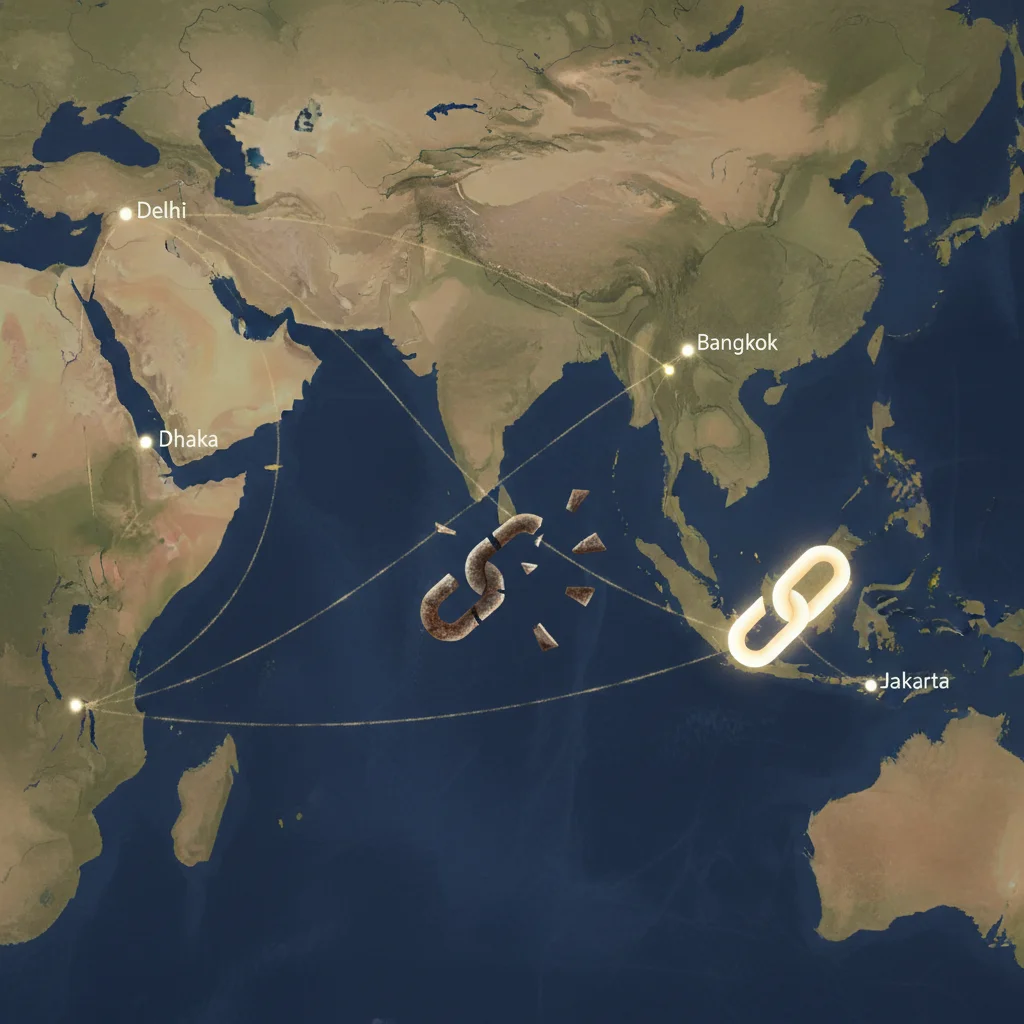
[IMAGE: A stylized map of South Asia and Southeast Asia with faint trade route lines connecting major cities (Delhi, Dhaka, Bangkok, Jakarta). In the center, a broken chain link symbolizing low integration, with a glowing, unbroken chain on the Southeast Asian side. Deep blue ocean background, no text, no watermark.]