South Asia’s Growth Paradox: Fastest-Growing Region Yet Struggling with Jobs,
South Asia remains the world''s fastest-growing region, driven by India,
South Asia’s Growth Paradox: Fastest-Growing Region Yet Struggling with Jobs, Gender Gaps, and Climate Shocks – A Deep Dive Analysis
South Asia continues to be the world’s fastest-growing economic region, propelled largely by India’s robust performance. Yet beneath the headline GDP figures lies a troubling disconnect: rapid macroeconomic expansion has failed to translate into broad-based labor market inclusion, gender equity, or resilience against climate shocks. An April 2026 update from the World Bank’s South Asia Economic Focus reveals that while the region’s overall growth remains strong, it is expected to moderate in 2026 as global energy market disruptions ripple through supply chains. This deep dive analysis examines the structural fractures—persistent informal employment, extreme gender exclusion, and escalating climate vulnerability—that challenge the narrative of a rising South Asia.
[IMAGE: A line graph comparing South Asia's GDP growth rate with employment-to-population ratio from 2010 to 2026, with annotations highlighting the widening gap.]
The Growth Paradox: Fastest in the World, Yet Millions Left Behind
South Asia’s gross domestic product has expanded at an average pace exceeding 6% over the past decade, outpacing all other developing regions. India alone accounts for the bulk of this momentum, driven by services exports, digital infrastructure, and manufacturing incentives. However, the South Asia Economic Update warns that growth is projected to slow to around 5.6% in 2026, partly due to supply disruptions from energy price volatility and geopolitical tensions.
The more alarming statistic, though, is the employment-to-population ratio: only 59% of working-age people in South Asia are employed. This figure is significantly lower than in East Asia (68%) or Sub-Saharan Africa (65%). The gap between GDP growth and labor market inclusion is not a temporary blip—it reflects a structural crisis where capital-intensive sectors and services create limited jobs relative to the size of the young, growing population. Every year, roughly 12 million new entrants join the workforce, yet the formal economy absorbs fewer than 2 million.
This growth paradox sets the stage for a critical examination of who benefits from expansion. The region’s informal sector, which accounts for an estimated 90% of total employment, remains the default absorber of labor—offering low productivity, no social protection, and minimal upward mobility. As the World Bank’s recent report underscores, without deliberate interventions, “growth without jobs” will deepen inequality and fuel social discontent.
[IMAGE: A split-frame photo: left side shows women working in a garment factory with poor conditions; right side shows a modern office setting with diverse employees. No text.]
The Employment Crisis: Where Are the Jobs?
The employment crisis in South Asia is most starkly visible in two dimensions: gender and formality. Female labor force participation stands at just 32%—among the lowest globally, trailing even the Middle East and North Africa. In countries like Bangladesh and Sri Lanka, rates are barely 36% and 35% respectively, while in Pakistan and India they hover around 25% and 30%. Cultural norms, safety concerns, lack of childcare infrastructure, and a severe shortage of decent work options confine millions of women to unpaid domestic labor or precarious informal earnings.
Formal sector employment accounts for only about 10% of the region’s workforce. In India, formal jobs—those with employer-provided social security—constitute roughly 8% of total employment. The rest are in agriculture, street vending, construction labor, and small-scale manufacturing, where wages are irregular and working conditions often unsafe. The COVID-19 pandemic exposed the fragility of this arrangement, as millions of informal workers lost livelihoods overnight with no safety net.
The World Bank Group’s jobs strategy in South Asia is built on three pillars: physical and human infrastructure, a business-ready policy environment, and private capital at scale. As Johannes Zutt, the World Bank’s Regional Director for South Asia, and economist Franziska Ohnsorge have argued, addressing the jobs crisis requires simultaneous action. Improving transport and digital connectivity can link rural workers to urban markets; investing in education and skills training—especially for women—can raise productivity; and simplifying business regulations can encourage formalization. Yet the current numbers reveal an urgent need to accelerate these efforts. The region is running out of time: with a median age of 27, South Asia has a narrow demographic window to create quality jobs before its population ages.
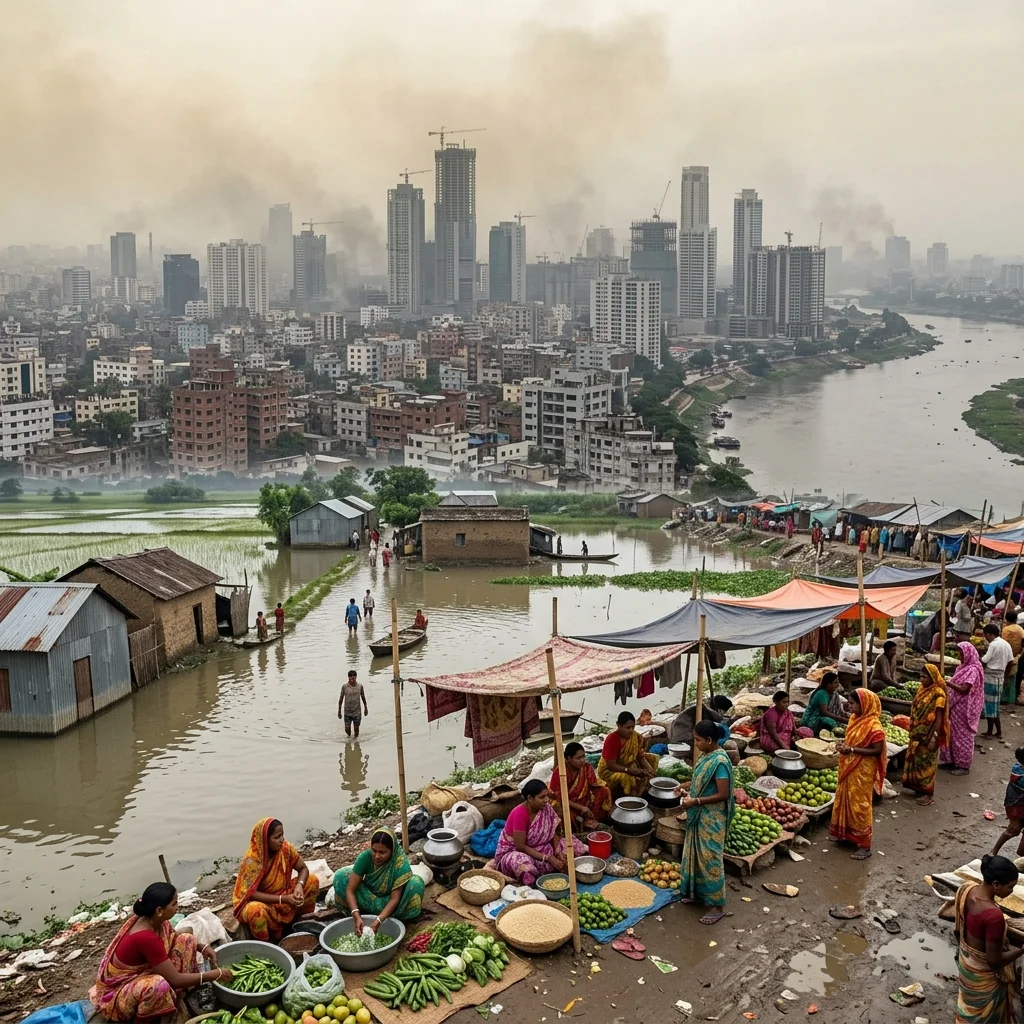
[IMAGE: A drone shot of a flooded village with crops submerged and people wading through muddy water, with a hazy, polluted skyline in the distance.]
Climate Shocks: A Silent Drag on Development
If the employment crisis is a structural fault line, climate change is the external shock that threatens to widen every crack. Since 2010, natural disasters—floods, cyclones, heatwaves—have affected an average of 67 million people each year in South Asia. Nearly 48% of the region’s population lives in climate-vulnerable hotspots, areas with unpredictable rainfall patterns, rising temperatures, and frequent extreme weather events. These include the Indus and Ganges river basins, coastal Bangladesh, and the Himalayan foothills.
The costs are staggering. In 2020 alone, climate-related disasters caused economic losses exceeding $50 billion across the region. But the damage is not evenly distributed: smallholder farmers, daily wage laborers, and women are disproportionately impacted. When a flood destroys crops, informal workers lose income they cannot recover. When heatwaves slash labor productivity, construction and manufacturing workers suffer reduced hours and earnings. The World Bank estimates that climate change could depress South Asia’s GDP by 2% to 4% annually by mid-century if adaptation measures are not scaled up.
Compounding the physical risks is environmental degradation. South Asia is home to nine of the world’s ten cities with the poorest air quality. Lahore, Delhi, Dhaka, and Kathmandu regularly record AQI levels exceeding 200—a “very unhealthy” category. Air pollution alone reduces labor productivity by an estimated 2% to 5% in exposed sectors, while causing millions of premature deaths annually. For women and children, the burden is heavier: they spend more time in polluted indoor environments due to cooking with solid fuels, further entrenching health inequities.
This climate–employment nexus creates a vicious cycle. Informal workers lack the resources to relocate or diversify livelihoods, making them more vulnerable to shocks. Yet their labor, often in agriculture or construction, is essential for rebuilding after disasters. Without targeted support—such as weather-indexed insurance, early warning systems, and social protection programs—climate shocks will continue to erode human capital and drag down inclusive growth.
[IMAGE: A map of South Asia with heatmap overlays showing climate vulnerability hotspots and formal employment density, highlighting the inverse relationship.]
The World Bank’s Priorities: A Three-Pronged Approach
Recognizing the interconnected nature of these challenges, the World Bank Group has articulated three strategic priorities for its South Asia engagement: job creation, climate resilience, and improved nutrition. In the April 2026 South Asia Economic Update, the institution emphasizes that these areas are not silos but mutually reinforcing. Creating jobs without addressing climate vulnerability is impossible, since many of the region’s labor-intensive sectors—agriculture, construction, tourism—are the most exposed. Similarly, improving nutrition is a prerequisite for human capital development; stunting rates in South Asia remain among the highest globally, affecting 35% of children under five, which limits cognitive development and future earning potential.
On job creation, the World Bank is scaling up investments in digital public infrastructure, such as India’s Unified Payments Interface and Bangladesh’s Digital Centers, which have already enabled millions of informal workers to access financial services and formalize transactions. On climate resilience, projects like the South Asia Water Gateway initiative aim to improve transboundary water management and flood forecasting, benefiting tens of millions. On nutrition, programs targeting the first 1,000 days of life—from pregnancy to a child’s second birthday—are being expanded, combining cash transfers with behavioral change communication.
Yet these efforts face enormous headwinds. The region’s fiscal space is constrained: average government debt-to-GDP ratios exceed 80%, limiting room for new spending. Political instability, policy unpredictability, and entrenched interests in the informal economy further complicate reforms. The World Bank acknowledges that progress will require not just more resources, but smarter alignment—linking infrastructure investments with skills training, and climate adaptation with social protection.
[IMAGE: Three side-by-side icons: a factory worker (jobs), a tree with water drops (climate), and a family with a child (nutrition), with connecting arrows showing synergies.]
The Hidden Economics of Informality and Gender Exclusion
Beyond the aggregate numbers, two hidden economic logics help explain why South Asia’s growth paradox persists. The first is the “informal subsidy”: employers in the informal sector enjoy lower labor costs by avoiding taxes, minimum wages, and social security contributions. This reduces the incentives for firms to formalize, while trapping workers in low-productivity arrangements. The government, in turn, forgone revenue that could fund public services. This creates an equilibrium where informality is rational for individual actors but suboptimal for the system.
The second logic is the “gender penalty.” When women are excluded from the labor force, the economy loses not just their current production but also their future productivity. Research by the World Bank and the International Labour Organization shows that closing the gender gap in labor force participation could boost South Asia’s GDP by 18% to 30%. Yet cultural norms and structural barriers—lack of safe transportation, unpaid care burdens, legal restrictions on women’s work in some sectors—persist. In Afghanistan and Pakistan, for instance, women’s mobility remains severely constrained, directly limiting their access to jobs.
These hidden logics are not accidental. They are reinforced by policies, historical legacies, and power structures. Breaking them requires a mix of regulatory reform, social norm change, and direct investment. Some success stories exist: Bangladesh’s ready-made garment industry, which employs 4 million workers—mostly women—demonstrates that when opportunities are created, women enter the workforce en masse. Yet even there, wages remain low and working conditions precarious.
[IMAGE: A bar chart comparing female labor force participation rates across South Asian countries, with regional average and global average lines annotated.]
The Way Forward: From Growth to Inclusive Development
The evidence from the April 2026 South Asia Economic Update and World Bank analyses suggests that the region is at a crossroads. Continued high GDP growth is possible, but without structural shifts, it will leave hundreds of millions behind. The key challenge is not to grow faster, but to grow differently—by creating enough productive jobs, integrating women, and building resilience to climate shocks.
Some countries are experimenting with innovative approaches. India’s government has launched a national apprenticeship program and expanded the MGNREGS public works scheme, which provide a floor for rural workers. Nepal is piloting digital land titling to help informal workers access credit. Sri Lanka has introduced a national social protection framework that includes climate-responsive cash transfers. These examples offer blueprints for scaling, but they remain fragmented.
The World Bank’s role, alongside other development partners, is to provide financing, technical expertise, and policy advice—but also to help shift the narrative. The growth paradox cannot be solved by more of the same. It requires recognizing that informality, gender exclusion, and climate vulnerability are not externalities but core features of South Asia’s economic model. Addressing them head-on is not only a moral imperative but an economic necessity.
[IMAGE: A photograph of a young woman working at a computer in a co-working space in Dhaka, Bangladesh, with a view of the city skyline through the window—representing the potential of a more inclusive digital economy.]
---
This deep dive analysis embeds data from the World Bank’s April 2026 South Asia Economic Update and draws on the Bank’s regional strategy for job creation, climate resilience, and nutrition. For further reading, see the full report at worldbank.org/south-asia-economic-update.