The Hidden Supply Chain Realignment in South Asia: Beyond the China+1 Narrative
While headlines focus on 'China+1' manufacturing shifts, a quieter, more
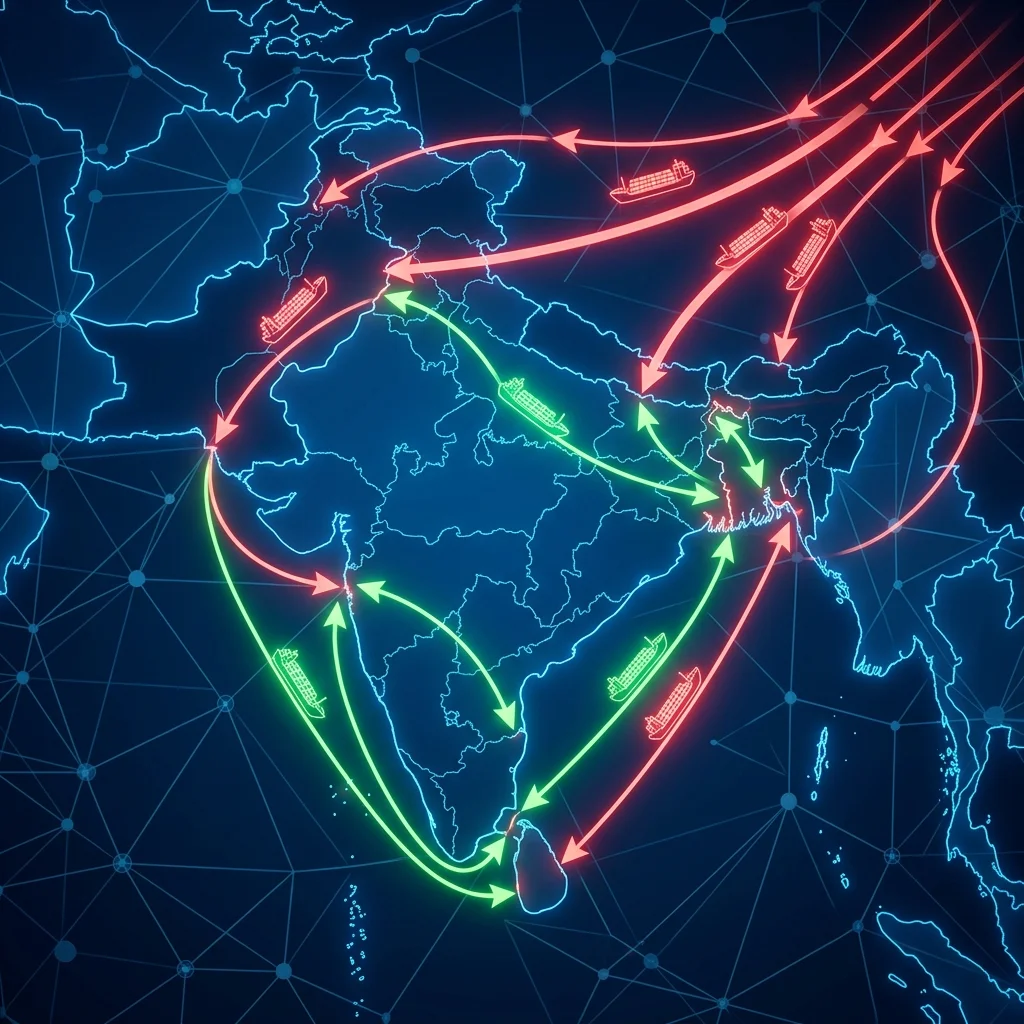
South Asia’s Supply Chain Realignment: Intra-Regional Trade Reshapes the Subcontinent
Subtitle: As the “China+1” narrative dominates headlines, a quieter structural shift is unfolding within South Asia itself—driven by India’s production-linked incentives, digital trade platforms, and cross-border renewable energy corridors.
---
Introduction: The Quiet Rebalancing of South Asia’s Economic Gravity
For the past decade, the dominant media narrative around global supply chains has been a simple one: factories are leaving China for alternative manufacturing hubs, and South Asia—particularly India, Bangladesh, and Vietnam—is the primary beneficiary. This “China+1” story is not wrong, but it is incomplete.
Beneath the headlines, a less-publicised but more structural realignment is underway within South Asia itself. Trade data, logistics investment patterns, and digital platform usage reveal that the subcontinent is not merely a passive recipient of relocating factories. Instead, it is building a self-reinforcing economic loop—one in which India’s scale and policy incentives create demand for intermediate goods from neighbouring economies, and those neighbours in turn become critical nodes in a regional production network.
Consider this anchor evidence: according to WTO regional trade statistics, intra-SAARC (South Asian Association for Regional Cooperation) trade in intermediate goods—components, parts, and raw materials used in further manufacturing—grew by 23% between 2019 and 2023, even as final assembly trade remained flat. This is not a blip. It reflects a deliberate shift toward regional sourcing that bypasses traditional long-haul routes and reduces dependence on Chinese supply chains.
[IMAGE: Line chart showing intra-South Asia intermediate goods trade value from 2018 to 2024, with annotations for key policy changes such as India’s PLI launch in 2019 and Bangladesh’s LDC graduation timeline. Source data from WTO and SAARC trade databases.]
The core thesis is that South Asia is becoming its own gravity centre. India’s Production-Linked Incentive (PLI) schemes, digital B2B platforms, and cross-border renewable energy corridors are collectively rewiring the region’s economic geography. This is not a zero-sum game against China; it is a parallel system that offers faster lead times, lower carbon footprints, and deeper integration for small and medium enterprises (SMEs) that have traditionally been excluded from global value chains.
This analysis will examine three distinct tracks of this realignment: the PLI spillover effect, the emergence of renewable energy corridors as new trade arteries, and the role of digital platforms in bridging trust and payment gaps across borders. The conclusion will assess the long-term implications for logistics, labour markets, and foreign direct investment (FDI) patterns in South Asia.
---
Track 1: The PLI Spillover Effect – India’s Domestic Push Becoming a Regional Engine
India’s Production-Linked Incentive (PLI) schemes, launched in 2020 and expanded across 14 sectors including electronics, pharmaceuticals, automobiles, and textiles, were designed to boost domestic manufacturing and attract foreign firms. The results have been significant: Apple suppliers like Foxconn and Wistron have expanded assembly operations in Tamil Nadu and Karnataka, while pharmaceutical giants such as Sun Pharma and Dr. Reddy’s have scaled up formulation production.
But the ripple effects extend far beyond India’s borders. The PLI schemes are creating “vendor park” ecosystems in neighbouring countries for components, raw materials, and intermediate goods. This is most visible in the textile and garment sector, where India’s export-oriented garment factories—supported by PLI-linked incentives—are increasingly sourcing woven fabrics from Bangladesh.
According to Bangladesh Garment Manufacturers and Exporters Association (BGMEA) data, Indian imports of Bangladeshi woven fabrics have surged by over 300% since 2020. The logic is straightforward: Bangladesh’s textile mills produce high-quality fabrics at competitive prices, while India’s PLI-supported garment units require shorter lead times to serve fast-fashion clients in Europe and the US. By sourcing regionally, these factories reduce shipping time from 4–6 weeks (from China) to 2–4 days via land border or sea routes from Chittagong to Chennai.
[IMAGE: Infographic showing the flow of intermediate goods from Bangladeshi textile mills to Indian PLI-supported garment factories. Digital platform icons (Udaan, Sheba.xyz) are placed along the flow, with time-reduction arrows indicating a 40% drop in lead times compared to Chinese sourcing.]
A similar dynamic is emerging in electronics. Sri Lanka’s printed circuit board (PCB) manufacturers, long dependent on Chinese imports of copper laminates and resins, are now supplying Indian electronics assemblers under the PLI scheme for mobile phones and IT hardware. The India-Sri Lanka Free Trade Agreement (ISFTA) provides tariff advantages, but the real catalyst has been the digitalisation of cross-border commerce.
Platforms like India’s Udaan (a B2B e-commerce marketplace) and Bangladesh’s Sheba.xyz (a procurement platform) are bridging the trust and payment gaps that historically hampered intra-regional trade. Udaan, which connects over 3 million retailers and manufacturers in India, recently launched a cross-border module that allows Bangladeshi and Sri Lankan suppliers to list products, receive payments in Indian rupees via a digital escrow system, and access real-time logistics tracking. The result: lead times for component orders have fallen by an average of 40% compared to traditional letter-of-credit methods.
This has profound implications for SMEs. Smaller Bangladeshi textile mills, which previously had no direct access to Indian garment factories, can now compete for contracts through digital platforms. The same is true for Nepali manufacturers of herbal extracts used in Indian pharmaceutical PLI units. In effect, the PLI schemes are not just Indian policy instruments; they are becoming regional production engines, pulling in intermediate goods from across the subcontinent.
However, challenges remain. Non-tariff barriers, such as India’s restrictive rules of origin under its free trade agreements and frequent customs delays at land ports (e.g., Petrapole-Benapole), still add friction. Recent customs digitisation efforts—notably India’s ICEGATE system and Bangladesh’s National Single Window—are helping, but harmonisation is slow. The 23% growth in intermediate goods trade could accelerate further if these bottlenecks are addressed.
---
Track 2: Renewable Energy Corridors – The New Infrastructure Backbone
While traditional trade routes—roads, railways, and ports—remain vital, a new infrastructure layer is emerging that is reshaping supply chain costs and attractiveness for foreign investors: cross-border renewable energy corridors.
The logic is simple. Manufacturing requires reliable, affordable electricity. In South Asia, national grid bottlenecks and power shortages have long been a constraint, particularly in Bangladesh, Pakistan, and parts of India’s eastern states. Instead of building large coal plants (which face financing and environmental hurdles), countries are turning to cross-border solar, wind, and hydropower projects that create “virtual” tariff-free trade zones for electrons.
Consider the case of the India-Nepal hydropower corridor. Nepal’s mountainous terrain generates enormous hydro potential—estimated at over 83,000 MW, of which only 1,200 MW is currently tapped. Under a series of bilateral agreements, Nepal is exporting surplus hydropower to India, with transmission lines that now carry over 600 MW daily. Indian garment and electronics factories in Uttar Pradesh and Bihar are increasingly pledging to use this green power in their supply chains, allowing them to qualify for lower carbon tariffs under the European Union’s Carbon Border Adjustment Mechanism (CBAM).
[IMAGE: Map of South Asia showing existing and planned cross-border renewable energy transmission lines: India-Nepal, India-Sri Lanka (proposed wind grid), and Bangladesh solar zone with connection to India’s eastern grid. Icons represent solar farms, wind turbines, and hydro dams.]
Data from the USAID South Asia Regional Energy Integration (SAREI) initiative shows that cross-border electricity trading volume in the region grew at an 18% compound annual growth rate (CAGR) between 2020 and 2024, from 3.2 GWh to 7.8 GWh. This growth is not accidental. It is driven by a convergence of factors:
- Cost advantage: Green electricity from Nepal (at ~$0.04/kWh) is cheaper than Indian coal-fired power (~$0.08/kWh) and far more predictable.
- Green premium: European and US buyers increasingly demand low-carbon supply chain certifications. Factories using cross-border renewable energy can document Scope 2 emissions reductions of 50–70%.
- Grid stability: Special economic zones (SEZs) in Bangladesh, such as the Bangabandhu Sheikh Mujib Shilpa Nagar (BSMSN), are now being designed with dedicated renewable energy feeders that bypass national grid fluctuations.
The deeper insight is that these corridors are becoming de facto tariff-free trade zones for electrons. Electricity exported from Nepal to India is not subject to customs duties or value-added tax, and the bilateral tariff is negotiated at a fixed rate. This creates a stable, low-cost power supply for manufacturing clusters that would otherwise face grid constraints. For example, the proposed India-Sri Lanka wind grid—a 100 MW undersea cable project scheduled for completion by 2026—would allow Sri Lankan industrial zones to tap into Indian wind farms in Tamil Nadu, reducing their reliance on expensive diesel-based backup generation.
This has direct implications for FDI patterns. When a European auto parts manufacturer evaluates a factory location in South Asia, it now considers not just labour costs and logistics, but also the availability of renewable energy certificates that can be bundled with its products. Bangladesh, which generates 42% of its electricity from imported LNG and coal, is actively seeking to sign renewable energy purchase agreements with Indian and Nepali generators to green its supply chain. The result is that renewable energy corridors are not just energy projects—they are trade enablers that lower production costs, attract green-conscience FDI, and reduce exposure to volatile global energy prices.
---
The Long-Term Impact on Logistics, Labour, and FDI
The intra-regional supply chain realignment described above is still in its early stages, but its trajectory is clear. If current trends continue, South Asia by 2030 will look fundamentally different from the region of today.
Logistics: The rise of digital trade platforms and customs digitisation will reduce the “time at border” for intra-regional shipments. Currently, the average inland transit time for a truck from Delhi to Dhaka is 12 days, with 5 days lost at the Petrapole-Benapole border. Pilot projects using electronic cargo tracking and pre-clearance systems have reduced this to 8 days. Scaling these innovations could cut logistics costs by 20–30%, making regional sourcing even more attractive compared to Chinese alternatives.
Labour markets: As Bangladesh, Sri Lanka, and Nepal integrate more deeply into India’s PLI supply chains, demand for semi-skilled labour in intermediate goods manufacturing will rise. Bangladesh’s ready-made garment sector, which employs 4 million workers, is already seeing a shift from simple cutting-and-sewing to higher-value fabric finishing and printing. Similarly, Nepal’s growing production of herbal extracts and specialty chemicals for Indian pharmaceutical PLI units is creating skilled jobs in fermentation and extraction. This shift could help address the region’s chronic underemployment and youth unemployment.
FDI patterns: Foreign investors that previously viewed South Asia as a collection of separate markets with high trade barriers are now beginning to see the region as an integrated production base. The “India plus one” locational strategy—where firms set up a core facility in India and a satellite unit in Bangladesh or Sri Lanka—is gaining traction. Japanese and Korean electronics firms, for example, are establishing component plants in Sri Lanka’s Hambantota Industrial Zone to serve their Indian assembly plants, leveraging the India-Sri Lanka FTA and the proposed renewable energy corridor.
However, this realignment is not without risks. Political tensions between India and Pakistan continue to block any meaningful trade integration in the western subcontinent. Bangladesh’s impending graduation from Least Developed Country (LDC) status in 2026 will strip it of preferential trade access to the EU and India, potentially undermining its competitiveness in intermediate goods. And India’s tariff structure—which remains relatively high for finished goods—could discourage deeper value chain integration if not reformed.
Still, the data points in one direction. The 23% growth in intermediate goods trade, the 18% CAGR in cross-border electricity trading, and the rapid adoption of digital platforms all suggest that South Asia is building its own economic gravity centre—one that reduces dependence on China while creating a more resilient, greener, and more inclusive regional economy.
The China+1 story is real. But the quieter story—the one about South Asia connecting to itself—may prove more consequential in the long run.
---
[IMAGE: Stylised map of South Asia (India, Pakistan, Bangladesh, Sri Lanka, Nepal, Bhutan, Maldives) with glowing digital trade routes and cargo ship icons superimposed. Green arrows flow from Bangladesh to India, Nepal to India, and Sri Lanka to India, with smaller bidirectional flows. Faded red arrows from China recede into the background. Abstract global supply chain nodes in the background. No text, no watermark.]