South Asia Economic Outlook 2026: India’s Engine Slows, Trade Reforms Offer
South Asia remains the world’s fastest-growing emerging-market region, but
South Asia Economic Outlook 2026: India’s Engine Slows, Trade Reforms Offer a Lifeline for the Rest
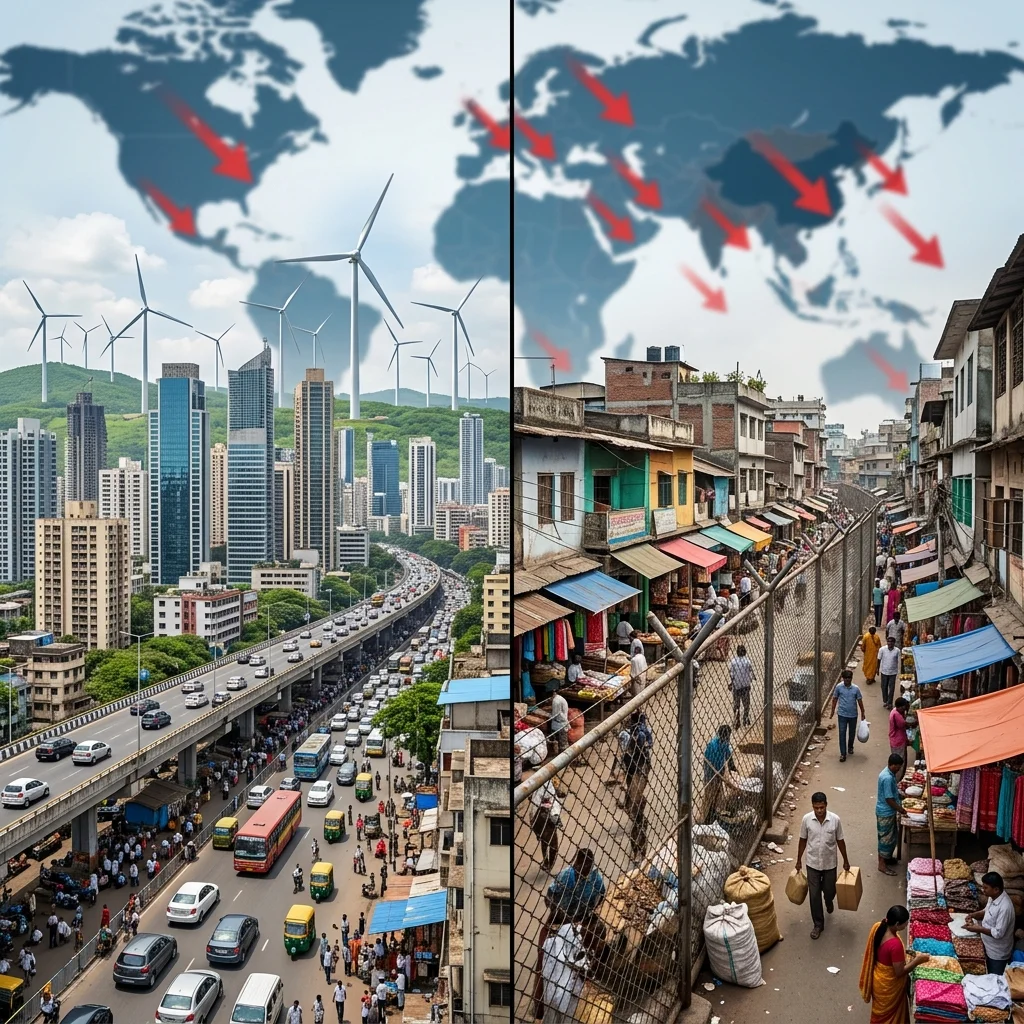
South Asia continues to hold the title of the world’s fastest-growing emerging-market and developing economy (EMDE) region, yet beneath the headline lies a stark divergence. The 2026 outlook reveals a region increasingly split between India’s powerhouse performance and the slower, more vulnerable trajectories of its neighbours. While India is projected to maintain robust growth of around 7% in 2026, the rest of South Asia is forecast to expand at just 4.1% — broadly on par with other EMDEs. However, a looming global energy market dislocation threatens to stall progress across the board, and analysts point to a critical, underused lever: trade reforms. This analysis unpacks the dual-speed dynamics, the hidden vulnerabilities to energy shocks, and how targeted policy changes could unlock a more resilient, inclusive growth path for the region.
The Twins of South Asian Growth: India vs. the Rest
South Asia’s rapid headline growth is almost entirely powered by India’s momentum. With a diversified services sector, a manufacturing base that is gradually expanding under policy initiatives like “Make in India,” and strong domestic demand, India is expected to clock GDP growth of approximately 7% in both 2025 and 2026. This positions the country as a global outlier in a period of slower global expansion. Yet the region’s aggregate numbers mask a fundamental structural divide.
Excluding India, South Asian economies — comprising Bangladesh, Pakistan, Sri Lanka, Nepal, Bhutan, and the Maldives — are projected to grow at just 4.1% in 2026, according to World Bank data. That is broadly in line with the average for all EMDEs, not the outperformance often implied by regional forecasts. Crucially, these economies are expected to pull ahead of other EMDEs by 2027, suggesting a delayed catch-up that depends on reforms and external conditions aligning.
[IMAGE: A bar chart comparing India vs. South Asia (ex-India) GDP growth rates for 2025-2027, with a clear annotation showing the 2026 slowdown and 2027 divergence.]
The divergence reflects structural differences that go beyond simple scale. India’s economy is powered by services (IT, finance, and business outsourcing) and a manufacturing sector that accounts for about 17% of GDP. In contrast, the rest of South Asia remains heavily reliant on agriculture, remittances, and commodity exports. Bangladesh’s garment industry, Pakistan’s textiles and agricultural produce, and Sri Lanka’s tea and tourism sectors are all highly exposed to external demand swings and global price fluctuations. Remittances, which exceed 5% of GDP in several of these countries, provide a buffer but also link household incomes to labour market conditions in the Gulf and other destinations. This structural composition makes the “rest of South Asia” more vulnerable to terms-of-trade shocks and less resilient to domestic policy missteps.
The risk of a two-speed recovery is real. If India’s growth moderates due to global headwinds or domestic capacity constraints, the region’s headline number would decline sharply. Conversely, if the smaller economies fail to close the gap, the political and social implications could deepen, especially as job creation lags. Understanding this twin-track dynamic is essential for investors and policymakers assessing the South Asia economic outlook 2026.
Energy Market Dislocation: The Hidden Brake on 2026 Growth
The global energy market dislocation — triggered by supply disruptions, geopolitical tensions, and persistent volatility in crude oil and natural gas prices — is the single most significant headwind for South Asia in 2026. For net energy importers, higher energy costs directly squeeze fiscal space, trade balances, and industrial output. Pakistan, Sri Lanka, and Bangladesh are among the most exposed, with energy imports accounting for a large share of total imports and often exceeding 3-4% of GDP.
Pakistan’s economy, already grappling with a fragile balance-of-payments position, faces renewed pressure if oil prices spike. Every $10 per barrel increase in crude prices adds roughly $1 billion to Pakistan’s import bill, fuelling inflation and widening the current account deficit. Sri Lanka, still recovering from its 2022 debt crisis, sees its fragile recovery endangered by higher energy costs that raise production expenses and erode the competitiveness of its key exports. Bangladesh, despite a resilient garment sector, feels the pinch through higher electricity generation costs and reduced consumer purchasing power.
[IMAGE: An infographic showing energy import dependency by South Asian country (percentage of GDP or total energy) with a red highlight on the dislocated global oil/gas price curve.]
Even India, with its strategic petroleum reserves and domestic coal production, is not immune. India imports about 85% of its crude oil and a growing share of natural gas. While the government can cushion domestic prices through fiscal measures and state-owned refiners, indirect spillovers through supply-chain inflation and investment uncertainty are unavoidable. Higher input costs for fertilisers, transportation, and industrial raw materials feed into core inflation, complicating the central bank’s monetary policy stance. Moreover, the energy shock exposes a deeper structural vulnerability: the region’s lack of diversified energy sources and inadequate cross-border power grids.
Deep insight: The energy dislocation is not just a short-term shock; it reveals a missed opportunity in regional energy trade. South Asia has enormous potential for cross-border electricity trade — for example, hydropower from Nepal and Bhutan to India and Bangladesh, or solar-generated electricity from India to Pakistan. Yet political mistrust, inadequate transmission infrastructure, and a lack of harmonised regulatory frameworks keep these flows far below their potential. A functioning regional energy market could buffer individual countries against price spikes and enhance energy security. Until such reforms mature, the region will remain acutely vulnerable to global energy market dislocations.
Trade Reforms: The Underused Engine for Resilience
If energy shocks represent the downside risk, trade reforms offer the most promising upside. The fact list underlying this outlook explicitly notes that reducing trade barriers could unlock further growth — a significant, often under-reported lever that could partially offset the drag from higher energy costs.
South Asia remains one of the least economically integrated regions in the world. Intra-regional trade accounts for only about 5% of total trade, compared to 60% in the European Union and over 25% in Southeast Asia. This is not because the region lacks complementarities; it is because tariff and non-tariff barriers remain high, logistics are poor, and trust is low. Red tape at borders, restrictive rules of origin, and a lack of mutual recognition of standards all discourage cross-border commerce.
[IMAGE: A map of South Asia with trade flow arrows between countries, highlighting the thinness of intra-regional trade compared to trade with the rest of the world. Percentage labels for intra-regional trade share (5%) vs. EU (60%) for comparison.]
The potential payoff is substantial. World Bank studies estimate that a 25% reduction in trade costs within South Asia could lift regional GDP by 2-3% within five years. That could be enough to push the non-India sub-region’s growth rate above 5% in 2027, even in the face of ongoing energy headwinds. Specific measures include lowering tariff peaks, streamlining customs procedures, harmonising product standards, and improving transport connectivity — particularly through India-Bangladesh border trade facilitation and the revival of SAARC corridor initiatives.
A nuanced viewpoint: Trade reforms are politically difficult but may become more feasible under external pressure. The need to counterbalance energy-driven inflation and to attract foreign direct investment (FDI) creates a stronger incentive for governments to open up. For example, Bangladesh’s graduation from Least Developed Country status by 2026 already requires it to reduce trade preferences, prompting New Delhi and Dhaka to revisit bilateral trade pacts. Similarly, Pakistan’s ongoing IMF programme includes conditions to liberalise imports and reduce trade distortions. If these pushes are coordinated, they could lay the groundwork for a more integrated regional market.
Moreover, trade reforms could diversify export baskets away from commodities and into higher-value manufactured goods and services, making economies less vulnerable to commodity price swings. They could also attract FDI from multinationals seeking to establish regional supply chains — particularly in sectors like automotive components, pharmaceuticals, and electronics, where India has already shown competitiveness.
Conclusion: A Fragile Window for Policy Action
The South Asia economic outlook 2026 presents a picture of contrast and fragility. India remains the region’s engine, but it cannot pull the entire train alone. The rest of South Asia faces a growth rate that, while expected to improve by 2027, is at risk of stagnation if the global energy market dislocation deepens. The region’s structural vulnerabilities — high energy import dependence, low trade integration, and political barriers to cross-border cooperation — amplify the impact of external shocks.
Yet the tools to break out of this trap are within reach. Trade reforms, though politically challenging, offer a clear, empirically grounded pathway to higher growth and greater resilience. Energy cooperation, while still nascent, holds the promise of reducing vulnerabilities. The window for action is fragile: if governments postpone reforms, the 2026 slowdown could become a prolonged plateau. But if they seize the moment, the region could not only weather the energy shock but emerge stronger, more integrated, and more inclusive.
For business news analysis and investors tracking the South Asia story, the key takeaway is to watch the policy signals as closely as the GDP numbers. India’s growth driver will continue to dominate the headlines, but the real story lies in how the rest of the region navigates the energy squeeze and whether trade reforms become the lifeline that analysis suggests they can be.