Beyond the 8% Drop: How HDFC Bank''s Slide Exposes Systemic Risk in India''s
HDFC Bank's sharp 8% decline on January 17, 2025, is more than a single-stock
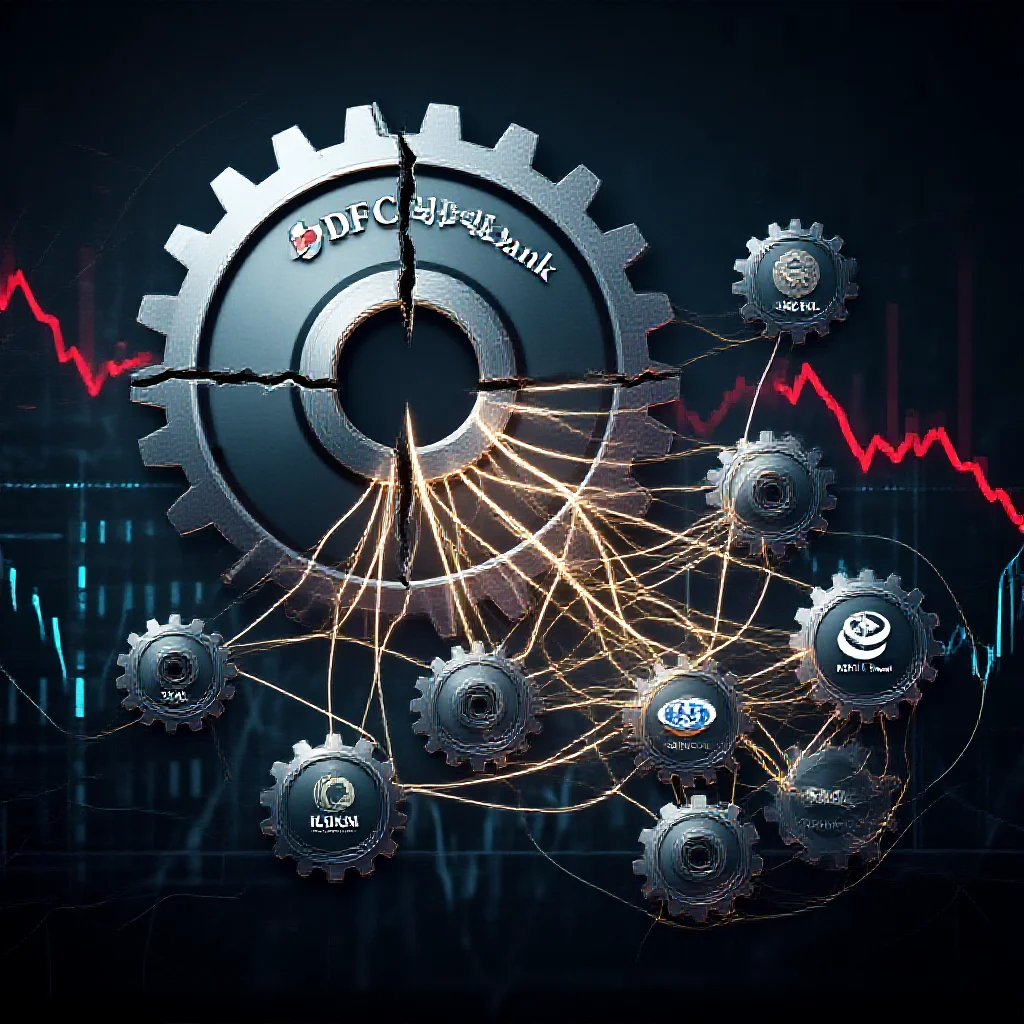
Beyond the 8% Drop: How HDFC Bank's Slide Exposes Systemic Risk in India's Mutual Fund Industry
The Trigger: An 8% Quake in India's Financial Fault Line
On January 17, 2025, HDFC Bank Ltd.’s share price declined by 7.98% (Source 1: [Primary Data]). This single-day movement represented a significant valuation erosion for India’s largest private lender. However, the event’s material impact extends beyond the bank’s market capitalization. The decline functions as a stress test for a financial architecture where mutual fund holdings in the bank total ₹1.23 lakh crore across 326 distinct schemes (Source 2: [Primary Data]). The analysis initiated by this price movement reveals not an isolated corporate event, but a tremor within a system constructed upon highly concentrated index weightings and mirrored portfolio mandates. The significance lies in exposing deep, structural linkages between a mega-cap equity and the broader asset management ecosystem.
The Foundation: HDFC Bank's Unavoidable Gravity in Indices
The concentration mechanism begins with passive benchmarks. HDFC Bank carries a 7.5% weight in the Nifty 50 index and a 13.5% weight in the Bank Nifty index (Source 3: [Primary Data]). This creates an "index trap." For passive funds tracking these benchmarks, the holding is a mandatory, mathematical requirement. For actively managed funds that use these indices as performance benchmarks, significant underweighting introduces high tracking error risk, discouraging substantial deviation. This institutional framework forces widespread ownership, establishing a feedback loop. The stock’s performance directly influences benchmark returns, which in turn affect the net asset values (NAVs) of a vast pool of funds, shaping broad market sentiment. The bank’s index weight is not merely a reflection of its size but a determinant of its systemic footprint.
The Amplifiers: Hybrid Funds as Concentration Vehicles
Data indicates the primary amplifiers of this concentration risk are funds categorized as hybrid. These products, which blend equity and debt components, are frequently marketed to retail investors as vehicles for moderated risk and volatility. The December 2024 holdings data contradicts this perception for several leading schemes. The SBI Equity Hybrid Fund held 9.72% of its assets in HDFC Bank. The ICICI Prudential Equity & Debt Fund held 9.63%. The HDFC Balanced Advantage Fund, Nippon India Equity Hybrid Fund, and Kotak Equity Hybrid Fund held 9.53%, 9.47%, and 9.44%, respectively (Source 4: [Primary Data]). This clustering of the top exposures within hybrid categories suggests a strategic convergence, potentially driven by a search for yield from a high-credit-quality equity, combined with the liquidity the large-cap stock provides. The result is a risk mismatch: investors allocating to funds perceived as "conservative" or "balanced" are exposed to significant single-stock volatility, as the January 17 decline demonstrated.
The Systemic Snapshot: ₹1.23 Lakh Crore of Interconnected Risk
The aggregate exposure figure of ₹1.23 lakh crore quantifies the systemic linkage (Source 2: [Primary Data]). This represents a substantial portion of the mutual fund industry’s equity assets under management (AUM), creating a critical vulnerability. The interconnection operates on two levels. First, a sustained downturn in HDFC Bank’s share price would exert direct downward pressure on the NAVs of hundreds of schemes simultaneously. Second, and more critically, it could trigger a liquidity feedback loop. Under significant redemption pressure, fund managers holding large, similarly concentrated positions may be forced to sell the same liquid large-cap stocks, potentially exacerbating the initial market decline. This transforms an idiosyncratic stock event into a broader market contagion channel. The architecture, built on compliance with index weights and peer-relative performance mandates, has created an unintended but potent systemic linkage.
Neutral Projections: Recalibration and Regulatory Scrutiny
The January 17 event is likely to initiate a multi-phase recalibration within India’s asset management industry. In the immediate term, risk management teams at mutual funds will conduct stress tests focused on single-stock concentration, particularly within hybrid categories. Fund houses may face increased scrutiny over product labeling and the communication of risk profiles to investors, especially where "balanced" or "hybrid" nomenclature may obscure high equity concentration.
Over the medium term, the Committee of Mutual Funds in India (AMFI) and the Securities and Exchange Board of India (SEBI) may evaluate guidelines concerning single-stock exposure limits within diversified schemes, especially for stocks with dominant index weights. The event highlights a regulatory dilemma: whether to manage concentration risk at the fund level when the source is the structure of the underlying market benchmark.
Market structure predictions indicate a potential, gradual shift. While HDFC Bank’s index weight is unlikely to change abruptly, the event underscores the systemic risk inherent in extreme benchmark concentration. This may accelerate interest in alternative indexing strategies, such as equal-weight or factor-based indices, among institutional investors. Furthermore, active fund managers may increasingly leverage the "benchmark-agnostic" label as a differentiation strategy, justifying underweights in mega-cap stocks to mitigate this identified linkage risk. The ultimate outcome will be determined by the trade-off between the efficiency of market-cap-weighted indexing and the financial stability costs of the systemic interconnections it creates.