Axis Bank''s Strategic Infusion: Decoding the Reduced Fundraising Target for
Axis Bank''s decision to invest ₹389 crore into its insurance subsidiary,
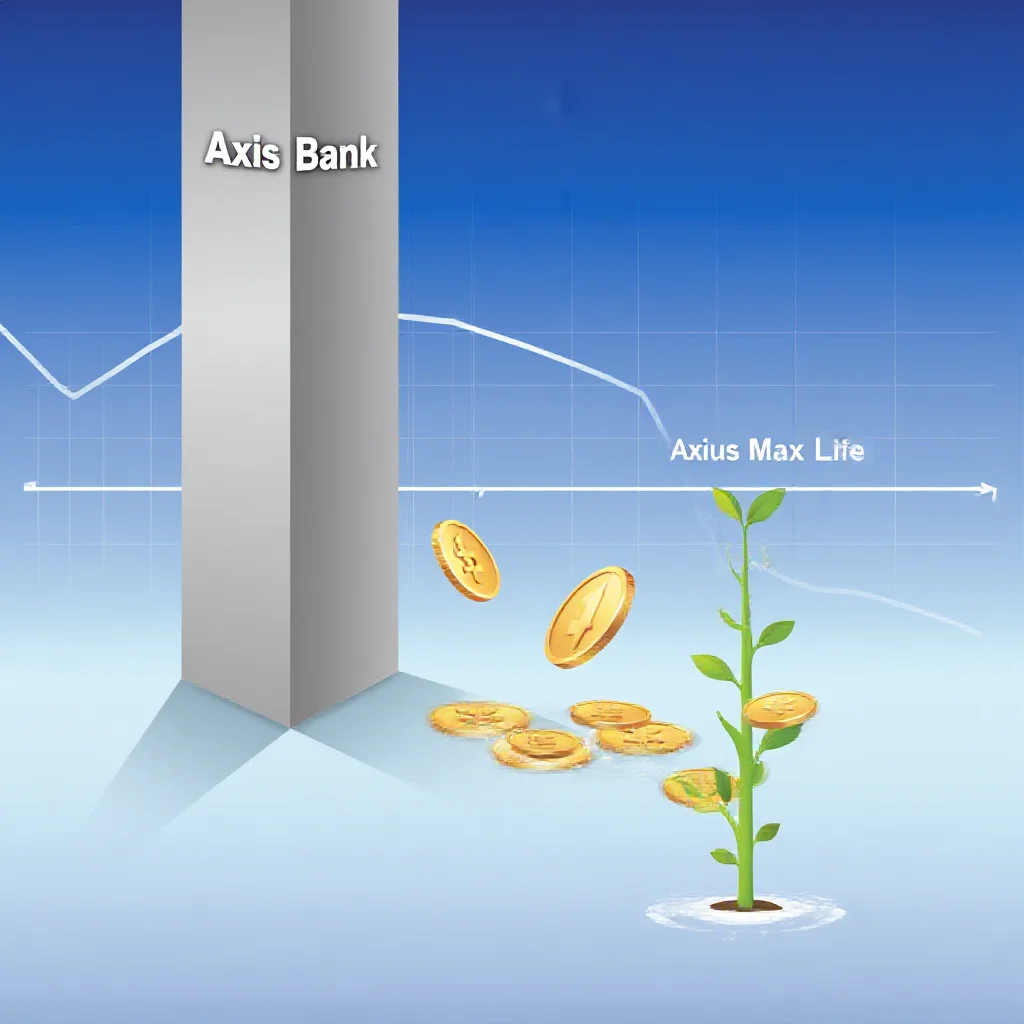
Axis Bank's Strategic Infusion: Decoding the Reduced Fundraising Target for Axis Max Life Insurance
Opening Factual Summary
Axis Bank has executed a capital infusion of ₹389 crore into its life insurance subsidiary, Axis Max Life Insurance. This transaction coincides with a material revision of the insurer's broader capital plan; its total fundraising target has been reduced to ₹1,600 crore. This dual action presents a strategic puzzle: a simultaneous injection of parent-company capital and a downward revision of the overall capital requirement. The move necessitates an analysis that separates the immediate financial support from the longer-term strategic signal it emits regarding the subsidiary's trajectory and the parent's capital allocation calculus.
Beyond the Headline: The Strategic Duality of Infusion and Reduction
The announcement contains two data points of opposing directional force. The ₹389 crore infusion represents a concrete, supportive action by the parent bank. Concurrently, the reduction of the fundraising target to ₹1,600 crore indicates a recalibration of ambition or need. This duality frames the central analytical question: is this primarily a demonstration of continued parental support, or a signal of strategically scaled-back expansion plans for the insurance venture?
The action cannot be interpreted as a simple capital boost. If the objective were merely to strengthen the subsidiary's balance sheet, a maintained or increased external fundraising target alongside the bank's infusion would be a more straightforward signal. The decision to lower the target suggests a more complex internal reassessment. It points to a potential reprioritization within Axis Bank's portfolio strategy or a revised internal forecast for Axis Max Life's capital consumption.
Decoding the 'Why': Market Realism vs. Strategic Patience
Three non-mutually-exclusive hypotheses can logically explain the strategic shift.
Hypothesis 1: Market Valuation Pressures. A primary driver may be the prevailing market environment for financial services valuations. A large, external fundraising round—whether from private equity or public markets—would require a consensus on the company's valuation. In a climate where investor appetite for new issuances is measured or where sectoral valuations are under pressure, pursuing a large round could be dilutive or unattractive. The bank-led infusion of ₹389 crore may represent a "bridge" or a strategic pause, allowing the subsidiary to strengthen its metrics for a more favorable future valuation before tapping external capital. This is a pragmatic response to external market conditions rather than an internal failure.
Hypothesis 2: Capital Efficiency & Internal Generation. The reduced target may reflect improved operational fundamentals at Axis Max Life. If the insurer's business has matured to a point where its operating cash flows and profit retention can fund a greater portion of its growth, its dependency on large, episodic external capital injections diminishes. The revised ₹1,600 crore target, supplemented by the bank's infusion, could then be sufficient to meet regulatory capital requirements and strategic investments. This hypothesis aligns with a natural evolution for a growing subsidiary, shifting from capital-hungry expansion to a more self-sustaining model.
Hypothesis 3: Revised Growth Roadmap. The decision may stem from a deliberate strategic pivot. Axis Bank and Axis Max Life's management may have recalibrated the growth plan from aggressive top-line market share capture to a more measured, profitability-focused expansion. A slower, more capital-efficient growth path would logically require a smaller war chest. This could be a response to the competitive dynamics of the Indian life insurance market, where competing with behemoths like LIC on pure scale is less viable than carving out a profitable niche, particularly through the parent's extensive bancassurance channel.
The Ripple Effects: Implications for Stakeholders and the Sector
The strategic move carries distinct implications for various stakeholders.
For Axis Bank: The ₹389 crore investment, while not material relative to the bank's total capital base, represents a conscious allocation of shareholder capital. The decision will be evaluated against alternative uses, such as deepening the core banking business or enhancing shareholder returns via dividends/buybacks. The bank's commitment must be justified by the risk-adjusted returns from the insurance venture. Analysts will monitor the impact on key metrics like the Common Equity Tier 1 (CET1) ratio, though the effect is likely marginal (Source 1: Axis Bank Investor Relations, Annual Report). The broader signal is one of disciplined capital allocation, favoring controlled, bank-funded support over a potentially dilutive external round.
For Axis Max Life: A reduced capital target alters its competitive posture. In a sector dominated by LIC and large private players like HDFC Life and SBI Life, capital enables investment in technology, distribution, and product innovation. A constrained capital plan may necessitate a more focused strategy, potentially doubling down on the bancassurance synergy with Axis Bank's network rather than expensive agency-led expansion or competing on guaranteed-return products that are capital intensive. Its ability to grow profitably within this framework will be the key test.
For the Insurance Sector: This move may be interpreted as a bellwether for other bancassurance-promoted or privately-held insurers. It signals that parent entities or promoters are taking a cautious, valuation-sensitive approach to funding growth, especially in a market where customer acquisition costs remain high and product margins are under scrutiny. It underscores a sector-wide shift in investor sentiment from rewarding pure growth to demanding sustainable profitability and capital efficiency.
Verification & Context: Reading Between the Financial Lines
Contextualizing the numbers is critical for a complete analysis. The ₹389 crore infusion should be assessed against Axis Bank's total annual investment outlays and its capital reserves to gauge materiality (Source 1: Axis Bank Investor Relations, Annual Report). For Axis Max Life, its performance metrics—such as Persistency Ratio, Solvency Ratio, and Value of New Business (VNB) margin—provide the necessary context. If persistency is improving and VNB margins are expanding, Hypothesis 2 (internal generation) gains credence. Conversely, if growth in Annual Premium Equivalent (APE) is slowing, Hypothesis 3 (revised roadmap) becomes more plausible. These benchmarks are available in regulatory filings and analyst reports (Source 2: IRDAI Annual Report; Source 3: CRISIL/ICRA Sector Updates).
Neutral Market/Industry Predictions
The strategic recalibration by Axis Bank and Axis Max Life is likely a precursor to similar moves across the sector, particularly for insurers without access to deep internal capital pools. The era of easily accessible growth capital for undifferentiated scale is closing. Future fundraising in the life insurance sector will be increasingly selective, tied to demonstrable paths to profitability and clear competitive advantages, especially in proprietary distribution. For bancassurance players, the imperative will be to maximize the efficiency and product penetration within their existing bank partner networks. Axis Max Life's journey under its revised capital plan will serve as a closely watched case study in capital discipline versus growth ambition in India's evolving life insurance landscape.